
Imagine your firm is preparing for a critical deposition. Your paralegals have meticulously organized the exhibits, the managing partner is reviewing the final case notes, and everything is moving smoothly. Suddenly, the screen freezes. You click to open your case management software, and the loading wheel just spins. Then, the entire network goes dark.
For a modern law firm, your biggest threat isn’t losing a case—it’s losing access to your case files.
If you manage a legal practice in Florissant or the Greater St. Louis area, you already know that the technology running your firm has never been more complex. But too often, IT is viewed simply as the “cost of doing business.” It’s time to shift that perspective. In the legal sector, your IT infrastructure is the armor protecting your client confidentiality, the engine driving your billable hours, and the foundation of your Missouri Bar compliance.
Let’s explore the true impact of technology on your legal practice, and how you can transform your IT from a frustrating bottleneck into your firm’s greatest operational advantage.
The “Billable Hour” Translation: Calculating Your True IT Risk
When generic IT providers talk to law firms, they often use terms like “latency,” “endpoint detection,” and “RTO (Recovery Time Objective).” But managing partners don’t bill for latency. They bill for time.
To understand the real importance of robust IT support, we have to look at network uptime through the lens of the billable hour. Consider the “Cost of Downtime” formula.
If your Florissant law firm has five attorneys billing at an average of $250 an hour, and a clunky Document Management System (DMS) or a slow server causes just two hours of collective network downtime a week, the math is staggering. That’s $2,500 a week in lost potential revenue. Annually? You’re looking at a $130,000 leak in profitability.
Slow VPNs during eDiscovery, split-billing software crashes, and frustrating network lags aren’t just “tech glitches”—they are HR and retention problems that lead to associate burnout and lost revenue.
The Trinity of Legal IT: Demystifying the Foundation
To protect your firm’s profitability and reputation, your technology strategy must be built on three non-negotiable pillars.
1. Absolute Data Security (The Data Custodian Mindset)
It’s time to adopt a new mindset: You are not just a law firm; you are a target-rich data repository. Cybercriminals know that law firms hold highly sensitive financial data, intellectual property, and personal identification.
Under the American Bar Association (ABA) Model Rule 1.6 (Confidentiality of Information) and Rule 5.3, attorneys have an ethical obligation to make reasonable efforts to prevent the inadvertent or unauthorized disclosure of client information. This means relying on consumer-grade antivirus software is no longer enough. You need enterprise-level protection, including persistent threat monitoring and Next-Generation Endpoint Security.
The 80/20 Rule of Legal Cybersecurity: 80% of data breaches happen due to 20% of vulnerabilities—most of which are human error. This is why continuous, automated security operations are vital.
2. Five-Nines Uptime (Access When it Matters)
“Five-nines” (99.999%) uptime is the gold standard for network availability. When litigators are in a St. Louis County courtroom, they need instantaneous, secure remote access to their files. A dropped connection can disrupt a trial strategy in seconds.
Achieving this level of uptime requires proactive 24/7 network monitoring that detects and resolves server issues before your staff even notices a slowdown.
3. Software Synergy (The “Heavy DMS” Reality)
Law firms run on unique, heavy-duty software ecosystems. Programs like Clio, MyCase, PracticePanther, and NetDocuments require specific bandwidth, API security, and backup redundancies that standard business IT simply doesn’t account for. Your IT infrastructure must be customized to handle the heavy lifting of your specific case management software without creating bottlenecks.
The Florissant Firm’s Compliance Matrix
Regulatory compliance isn’t just a box to check; it’s a continuous operational state. For law firms in Florissant, maintaining compliance means navigating a web of federal and state guidelines:
- ABA Model Rules: Demands absolute client confidentiality and secure communication channels. Practically speaking, this means replacing the habit of emailing sensitive PDF attachments with the use of encrypted, secure client portals.
- HIPAA: If you run a Personal Injury or Medical Malpractice firm, you are handling Protected Health Information (PHI). Your IT environment must meet stringent HIPAA data encryption and access tracking standards.
- Missouri Bar Guidelines: State-specific guidelines demand that lawyers maintain technological competence, understanding the risks associated with the software and cloud services they use.
Myth vs. Reality: Where Law Firms Get Stuck
As firms attempt to modernize, they often fall victim to common technological misconceptions. Let’s clear a few up.
Myth: Our firm’s data is in the cloud (like Microsoft 365 or Google Workspace), so it’s automatically backed up and safe.
Reality: Cloud synchronization is not a true backup. If an employee accidentally deletes a file locally, or a ransomware attack encrypts a localized folder, that change syncs to the cloud immediately. Without a proper Backup & Disaster Recovery (BDR) plan that takes separate, verified snapshots of your data, cloud files can be permanently lost.
Myth: We have an “IT guy” who fixes our computers when they break, so we’re covered.
Reality: The “break-fix” model is inherently reactive. If you are calling an IT guy, you are already losing billable hours. Modern legal IT requires dedicated specialist teams (cybersecurity experts, cloud engineers, and strategists) who proactively maintain the network so things don’t break in the first place.
Architecting a Zero-Downtime Environment: The ThrottleNet Approach
So, how do you practically achieve this level of operational excellence? It requires moving away from generalist IT support and partnering with specialists who understand the stakes.
ThrottleNet has spent years engineering IT and cybersecurity solutions designed to keep St. Louis and Florissant businesses running without interruption. We understand that legal professionals need problems solved with speed and accuracy.
Here is how our unique managed IT structure protects your firm:
- Unmatched Speed to Resolution: While other providers route you through slow “Level 1” bottlenecks, ThrottleNet utilizes a multi-tiered help desk of specialized engineers. This allows us to boast an industry-leading 90-second average response time and a 93% same-day resolution rate.
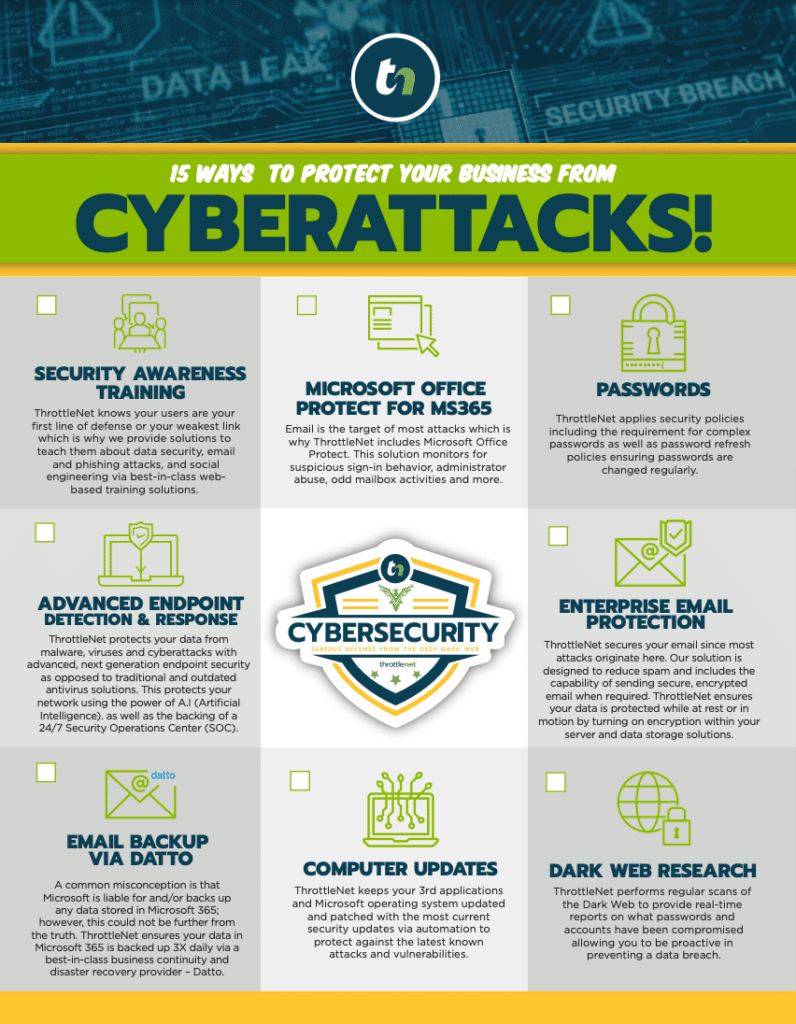
- Bulletproof Cybersecurity: We don’t just offer security as an add-on. Every client is backed by a 24/7 Security Operations Center (SOC). Our proactive threat protection is so effective that no ThrottleNet customer has ever paid a ransomware attack. We back this promise with our exclusive $500,000 Cybersecurity Protection Program.
- Strategic Growth with a vCIO: You don’t just get an account manager; you are paired with a dedicated Virtual Chief Information Officer (vCIO). They work with your managing partners to build long-term technology roadmaps, ensure vendor compliance, and manage your IT budget efficiently.
Frequently Asked Questions (FAQ)
What is managed IT support for small law firms?
Managed IT support is a comprehensive, proactive approach where a third-party team of experts takes turnkey responsibility for your firm’s entire technology ecosystem. Instead of charging you hourly to fix broken computers, a Managed Service Provider (MSP) like ThrottleNet provides 24/7 monitoring, robust cybersecurity, cloud management, and strategic planning for a predictable monthly cost.
Why is our case management software so slow?
Sluggish software is rarely the fault of the software itself. It is usually caused by insufficient network bandwidth, aging local servers that cannot handle the demands of modern eDiscovery, or a lack of proper integration between your Document Management System and your operating system.
Should our legal practice use cloud or on-premise servers?
The legal industry is rapidly shifting to the cloud for its superior accessibility, scalability, and built-in disaster recovery capabilities. A well-architected cloud environment (like Microsoft Azure) allows attorneys to securely access case files from courtrooms or home offices without the massive capital expense of replacing physical, on-premise servers every five years.
Next Steps: The ThrottleNet Professional Services Blueprint
Your firm’s technology should be a silent partner that empowers your attorneys to do what they do best: practice law and serve clients. If you are experiencing recurring tech headaches, worrying about the security of your client data, or wondering if your current IT setup would pass a compliance audit, it’s time to evaluate your environment.
The first step toward uninterrupted billable hours and total peace of mind is understanding exactly where your vulnerabilities lie.
ThrottleNet offers a comprehensive, free on-site IT assessment and security report for businesses in Florissant and the Greater St. Louis area. We will help you identify hidden workflow bottlenecks, evaluate your true risk exposure, and build a customized roadmap to secure your firm’s digital future.