
Accounting firms store a large amount of sensitive data that they need to protect. This data can include everything from client information to financial records. If firms don’t have an adequate level of accounting cybersecurity, they can be easy targets for cyber criminals. Recovering from cyber attacks can be costly both financially and in terms of clients’ continued trust in your company.
In 2020, the recovery cost from cyber attacks worldwide was thought to reach $1.5 trillion annually. Because of the confidential information accounting firms handle and store, they’re one of the most likely businesses to be attacked by cyber criminals. Reinforcing accounting cybersecurity is an important measure for ensuring proper network safety.
As cybersecurity is a critical issue for accounting firms, it’s important to take steps to protect your data and your firm from potential attacks. We’ll discuss ways of securing data and preventing cyber attacks.
What Types of Cyber Threats Do Accounting Firms Face?
As previously stated, hackers often target accounting firms because they store a large amount of sensitive data, and they sometimes lack the accounting cybersecurity infrastructure to prevent attacks. There are many different types of attacks that accounting firms need to be aware of. Some of these include:
1. Malware Attacks: Malware is a type of malicious software that’s designed to damage or disable computers. It can be used to steal information, delete data, or even take control of entire systems.
2. Phishing Attacks: Phishing is a type of cyber attack that’s designed to trick victims into giving up their personal information in order to steal their identity or gain access to their network. Hackers will often send emails that appear to be from legitimate businesses in order to do this.
3. Denial-of-Service Attacks: Denial-of-service (DoS) attacks are designed to make a computer or network unavailable to its users. These attacks can be conducted in a number of ways, but the goal is to disable a system so that it can’t be used. DoS attacks are often used as a way to distract from other cyber attacks, like malware or phishing attacks.
4. SQL Injection Attacks: SQL injection attacks are a type of attack that’s designed to take advantage of vulnerabilities in web applications. These attacks allow attackers to execute malicious SQL code on a database, which can allow them to access sensitive data.
5. Man-in-the-Middle Attacks: Man-in-the-middle (MITM) attacks are a type of attack where a hacker inserts themselves into a communication between two parties. This allows the attacker to intercept and read data that’s being sent between the two parties.
How to Strengthen Accounting Cybersecurity to Prevent Cyber Attacks
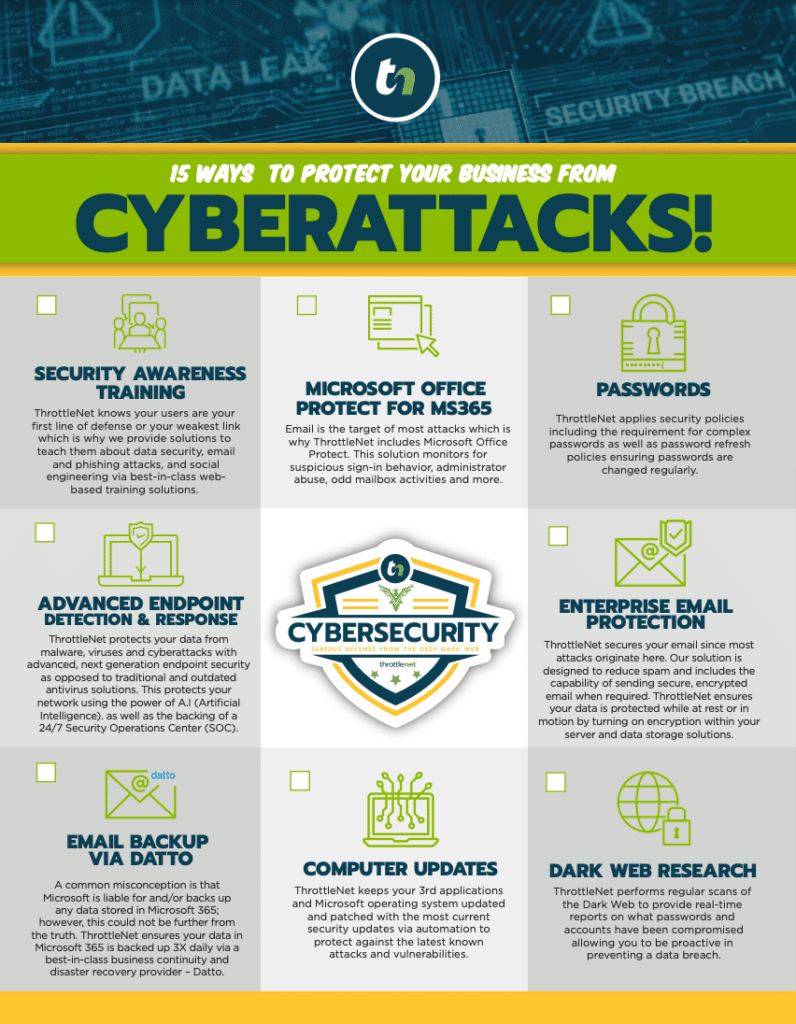
It’s essential for accounting firms to strengthen their infrastructure to prevent attacks from happening. There are a number of ways that accounting firms can strengthen their cybersecurity, including:
- Implementing cybersecurity measures like firewalls and anti-virus software.
- Regularly updating software and firmware on devices.
- Restricting access to sensitive data only to those who need it.
- Backing up data frequently.
- Training employees in how to spot and respond to cyber threats.
- Having a disaster recovery plan in place in case of a cyber attack.
Partner with ThrottleNet to Protect Your Accounting Firm
ThrottleNet is the perfect solution for accounting firms who want to ensure their data is safe and secure. We offer a variety of services that help reinforce cybersecurity, including firewalls, system monitoring, and employee trainings. Contact us today to keep your accounting firm safe from cyber threats.