
Picture this: It is 8:30 AM on a Tuesday. Your team is preparing for a massive client presentation or trying to process a critical batch of orders. Suddenly, the server crashes. Operations grind to a halt, employees are staring at their screens in frustration, and you are scrambling to call your “IT guy,” hoping he isn’t tied up on another job.
For many small and mid-sized businesses in St. Charles and the greater St. Louis area, this anxiety-inducing scenario is just considered a normal part of doing business. It is the classic “If it ain’t broke, don’t fix it” approach to technology.
But behind the scenes, a quiet shift is happening. Local CFOs, operations managers, and business owners are realizing that waiting for things to break is an incredibly expensive way to operate. Instead, they are moving toward a model called Proactive Managed IT Services.
If you have ever wondered why your technology feels like a constant roadblock rather than an accelerator, or if you are simply tired of unpredictable IT bills, you are in the right place. Let’s pull back the curtain on how IT support is fundamentally changing, and why it matters for your bottom line.
The “Aha!” Moment: The Fundamental Flaw of Break-Fix IT
To understand why businesses are switching, we first have to look at the traditional IT model, often referred to as “break-fix.”
Think of a break-fix IT provider like a firefighter. You only call them when the house is on fire. They rush in, put out the blaze, send you an hourly bill, and leave until the next fire starts.
Here is the uncomfortable truth about the break-fix model: The incentives are completely misaligned.
In a reactive model, your IT provider profits from your pain. If your network goes down, they make money. If a virus infects your computers, they make money. They have no financial motivation to prevent the fire from starting in the first place because they are paid strictly by the hour to put it out.
Proactive Managed IT Services flips this incentive structure on its head. Instead of a firefighter, a Managed Service Provider (MSP) acts like a health inspector. They install the smoke detectors, upgrade the wiring, and monitor the temperature to ensure a fire never starts.
Because MSPs operate on a predictable, flat monthly rate, they lose money when you experience downtime. If they have to spend 10 hours fixing your server, it costs them labor. Therefore, an MSP is financially incentivized to keep your business running flawlessly. They win when you win.
The Iceberg Analogy: The True Cost of Downtime
Many business leaders hesitate to switch to managed services because they compare the flat monthly fee to the sparse hourly bills they get from their current IT guy. But this is like looking at the tip of an iceberg.
The visible cost of break-fix IT is just the hourly rate and the hardware replacements. But the massive, hidden underwater costs are what actually sink profitability:
Lost Employee Productivity: If your network is down for four hours, you are still paying your 20 employees their hourly wage to sit around unable to work.
Plummeting Morale: Employees hate working on slow, broken, or outdated technology. It leads to frustration, burnout, and eventually, turnover.
Security Breach Recovery: Recovering from a ransomware attack can cost hundreds of thousands of dollars in downtime, legal fees, and reputational damage.
Opportunity Cost: When your leadership team is busy dealing with tech headaches, they aren’t focusing on growing the business.
When you add the true cost of employee downtime to your hourly IT bills, you are likely dramatically overpaying for reactive support.
The 4 Pillars of Proactive Managed Services
So, what exactly does a proactive MSP do differently to prevent these issues? The best providers build their service on four core pillars.
1. 24/7 Monitoring (Catching the Smoke Before the Fire)
Instead of waiting for you to call and report a problem, an MSP uses advanced software to monitor your network around the clock. At ThrottleNet, for example, our proactive monitoring often detects and resolves failing hard drives or network bottlenecks before the client even realizes there was an issue.
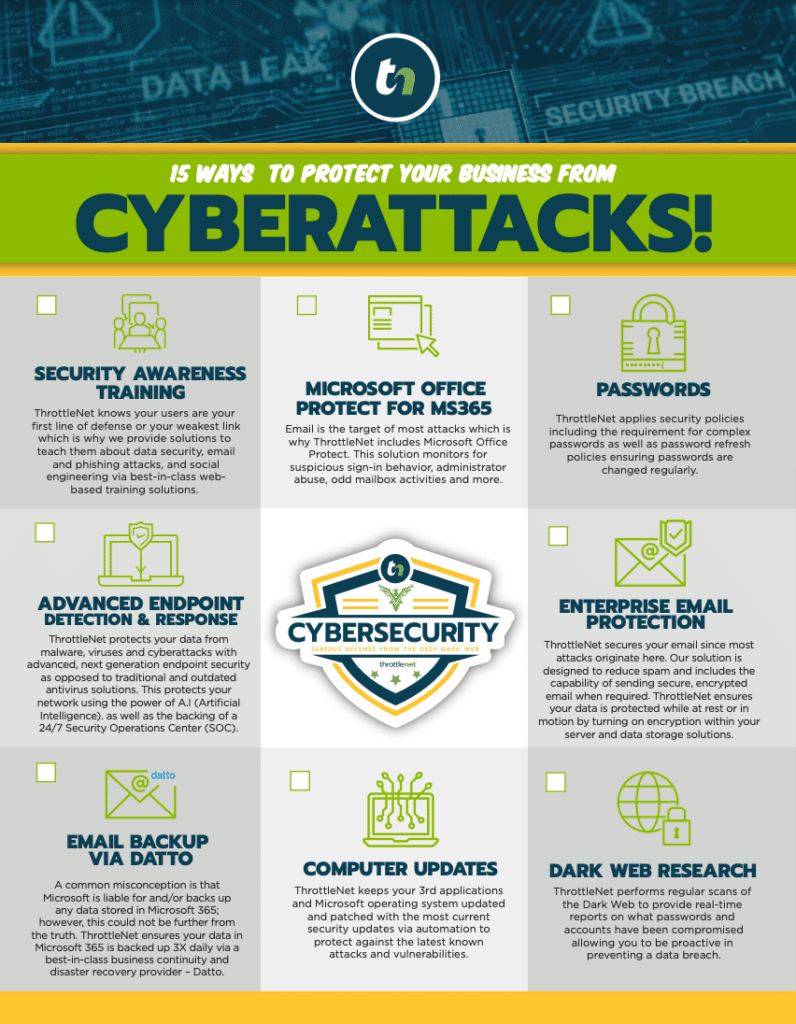
2. Robust, Layered Cybersecurity
Basic antivirus software is no longer enough. Modern cyber threats require a dedicated Security Operations Center (SOC), persistent threat hunting, next-generation endpoint protection, and backup verification. By embedding cybersecurity into the foundation of your network, top-tier MSPs dramatically reduce the risk of downtime. (In fact, no ThrottleNet customer has ever had to pay a ransomware attack).
3. Strategic Planning with a vCIO
Technology shouldn’t just be an expense; it should fuel business growth. Premium managed services include a Virtual Chief Information Officer (vCIO). Unlike a standard “account manager” who just tries to sell you new hardware, a dedicated vCIO builds long-term technology roadmaps, assists with IT budgeting, and aligns your technology with your business goals.
4. Fast, Multi-Tiered Support
When you do need help, you shouldn’t have to wait in a queue for hours. While traditional IT relies on generalists, proactive MSPs use a multi-tiered help desk staffed by specialists. Because issues are immediately routed to the correct level of engineering talent, problems are solved faster. This is how ThrottleNet achieves an industry-leading 90-second average response time and a 93% same-day resolution rate.
The Financial Tipping Point: When is it Time to Switch?
A common question among St. Charles business owners is, “When do we outgrow the IT guy?”
A helpful benchmark is The 10-Employee Rule. Once a business reaches about 10 employees, the complexity of managing file sharing, security permissions, email hosting, and device support typically exceeds the capabilities of a reactive model.
Financially, industry standards for comprehensive Managed IT Services range from $150 to $300 per user, per month, depending on the complexity of your network and security needs. If you calculate the hours your staff currently wastes wrestling with tech issues, you usually find that managed services pay for themselves in recaptured productivity alone.
What if We Already Have an Internal “IT Guy”?
This is incredibly common for businesses with 50 to 200 employees. You have a dedicated internal IT manager, but they are acting as a jack-of-all-trades. They are so busy resetting passwords and setting up new laptops that they don’t have the bandwidth to tackle strategic projects or enterprise-level cybersecurity.
This is where Co-Managed IT comes in.
Co-managed IT isn’t about replacing your internal team; it is about giving them a superpower. You partner with an MSP to offload the tedious daily help desk tickets and 24/7 network monitoring, freeing up your internal staff. Alternatively, your team can keep the daily help desk, while the MSP handles the complex cybersecurity (backed by tools like ThrottleNet’s $500,000 cybersecurity protection program). It reduces internal burnout and gives your staff access to enterprise-grade tools they wouldn’t have on their own.
Demystifying the Switch: The 5-Step Transition Roadmap
One of the biggest reasons businesses tolerate bad IT is the fear that switching providers will cause massive operational disruption. A professional MSP eliminates this anxiety through a structured, painless onboarding process—usually completed in 30 days without downtime.
- Audit & Document: The new provider maps your entire network, documenting every detail, password, and vendor contact.
- Deploy & Secure: Proactive monitoring tools and advanced cybersecurity protections are installed silently in the background.
- Centralize Command: Your technology is brought into a single intuitive dashboard (like the TN TechHub), giving you total visibility into your IT health.
- Train the Team: Your employees are trained on how to easily request support and how to spot phishing attacks, ensuring a smooth user experience.
- Strategize: You hold your first strategic alignment meeting with your vCIO to map out a technology roadmap for the upcoming year.
Frequently Asked Questions (FAQ)
What is the difference between IT support and managed services?
IT support (break-fix) is reactive; you pay an hourly rate to have someone fix a specific problem after it occurs. Managed IT services are proactive; you pay a flat monthly fee for a team to constantly monitor, maintain, and secure your network to prevent problems from happening in the first place.
Is managed IT good for small businesses?
Absolutely. Small businesses are actually the most vulnerable to cyberattacks and data loss because they often lack enterprise-grade defenses. Managed services give small businesses access to an entire team of specialists (cloud, networking, cybersecurity) for a fraction of the cost of hiring one full-time internal IT employee.
How do you monitor my network without spying on employee data?
This is a common and valid concern! MSPs use Remote Monitoring and Management (RMM) software. This software looks at system performance metrics—like CPU usage, hard drive health, and software patch status—not personal data. We are monitoring the health of the machine, not reading your employees’ emails or documents.
How does predictable flat-rate billing work?
Instead of an unpredictable bill that spikes every time something breaks, you pay a consistent, agreed-upon monthly rate based on the number of users or devices you have. This allows you to budget for IT like a standard utility, eliminating financial surprises.
Ready to Stop Fighting Fires?
Transitioning from a reactive “break-fix” approach to proactive Managed IT Services is one of the most impactful operational decisions a growing business can make. It transforms technology from a daily source of frustration into a reliable engine for growth.
By aligning your IT partner’s incentives with your own, you secure not just your network, but your peace of mind. Your employees get back to doing what they do best, your data remains secure against modern threats, and your leadership team gains a strategic partner invested in your long-term success.
If you are a St. Charles or St. Louis area business owner curious about what a proactive IT environment could look like for your specific operations, the best first step is a simple conversation. Exploring your options costs nothing, but staying stuck in a reactive cycle could be costing you everything.