
You already know not to click links from “foreign princes” offering you millions of dollars. Your team knows that, too.
But what if the email isn’t an obvious scam? What if it’s a catering receipt for a local St. Louis pizza place your office orders from weekly? What if it’s a notice about a “delivery exception location security restriction” for a package headed to your Chesterfield office? Or a billing update from that HVAC vendor you literally just spoke with yesterday?
It looks normal. It feels mundane. And that’s exactly why it works.
When national tech giants talk about cybersecurity, they often use massive, abstract examples. But the reality is much closer to home. According to the FBI’s Internet Crime Complaint Center (IC3), Business Email Compromise (BEC) and email spoofing have cost businesses over $50 billion globally. Yet, these attacks don’t usually start with a cinematic hack into a mainframe. They start with a highly targeted, localized email designed to blend perfectly into your team’s daily St. Louis workflow.
Let’s pull back the curtain on how cybercriminals are using local context to bypass generic spam filters, and exactly what you can do to protect your organization.
Decoding the Threat: Phishing vs. Business Email Compromise (BEC)
To build an effective defense, we first need to understand the tools hackers are using against us. While the terms “phishing” and “BEC” are often used interchangeably, they are distinct tactics.
Phishing is a wide net. Attackers send out thousands of generic emails hoping a few people will click a malicious link or download an infected attachment. They are banking on the law of averages.
Business Email Compromise (BEC) is a sniper rifle. In a BEC attack, a cybercriminal carefully researches your specific business. They impersonate an executive, a trusted vendor, or a local partner to trick an employee into transferring funds, changing payroll routing numbers, or handing over sensitive data.
The “4 P’s” of Spotting Email Fraud
Federal agencies like the Department of Veterans Affairs use a highly effective framework to train staff on spotting fraud, known as the “4 P’s.” Whether an attacker is casting a wide net or using a sniper rifle, their emails almost always contain these four elements:
- Pretend: The sender pretends to be an organization or person you know and trust.
- Problem (or Prize): They claim there is a problem you must fix immediately (like a declined payment) or a benefit you must claim.
- Pressure: They create a sense of extreme urgency. If you don’t act now, a shipment will be returned, or a vendor will cancel a contract.
- Pay: They require you to click a link, provide login credentials, or alter financial routing details.
The Anatomy of a Localized Attack
Most cybersecurity guides use the “CEO asking for a wire transfer” as their only example of a BEC attack. But the truth is, hackers know your finance director is on high alert for wire requests. Instead, they target HR staff, administrative assistants, and entry-level employees with localized lures.
Here is how scammers use St. Louis against you:
1. The Logistics Lure
The Scenario: Your office manager receives an email titled “Delivery exception location security restrictions.” The email contains a realistic-looking tracking number and a button that says “Resolve Delivery Issue.”Why it works: Businesses send and receive packages every day. If an employee thinks a crucial shipment of office supplies or client materials is stuck at a local St. Louis distribution center, their instinct is to fix it quickly. Clicking the link takes them to a fake Microsoft 365 login page, where their credentials are stolen the moment they type them in.
2. The Corporate Travel & Catering Lure
The Scenario: An HR coordinator receives an unexpected “Domino’s confirmation email” for a massive catering order, or a “Sheraton Essen email” confirming a block of hotel rooms.Why it works: The employee knows they didn’t place this order. Panicked about an unauthorized charge on the corporate card, they immediately click the “Cancel Order” or “View Invoice” link. Again, this link deploys malware or harvests their passwords.
3. The Local Vendor Spoof
The Scenario: Hackers scrape local directories, like the St. Louis Chamber of Commerce, to see who you do business with. They then buy a domain name that is exactly one letter off from your actual vendor (e.g., [email protected] instead of [email protected]). They email your accounts payable department: “Hi, we’ve updated our bank routing info for this month’s invoice.”Why it works: The context is entirely accurate. The timing makes sense. The generic spam filter sees no malicious links or malware—just a plain-text email from what looks like a trusted source.
Explain it to My Team: The 3-Bullet Takeaway * Hackers research our business to make fake emails look incredibly realistic. * Always double-check unexpected catering receipts, hotel confirmations, or “delivery exception” alerts. * Never click a link to cancel an unauthorized order; navigate to the vendor’s actual website independently.
Why Generic Spam Filters Fail (And Local Intelligence Wins)
You might be wondering, “Don’t we pay for an email filter to stop this?”
Out-of-the-box spam filters from global providers are excellent at catching generic, mass-produced junk mail. But they operate on macro-level algorithms. They don’t know that your company strictly uses a specific local catering company, or that a sudden influx of emails spoofing St. Louis-area construction firms is currently trending in the Midwest.
This is where advanced technical layers become non-negotiable:
- DMARC, SPF, and DKIM: These are email authentication protocols. Think of them as digital bouncers that verify an email actually came from the domain it claims to be from. If a hacker tries to spoof your domain to email your employees, DMARC stops it from ever hitting the inbox.
- Secure Email Gateways (SEGs): Advanced SEGs use behavioral AI to detect anomalies. If an email claims to be from your boss, but it originated from an IP address in Eastern Europe at 3:00 AM, the system flags it.
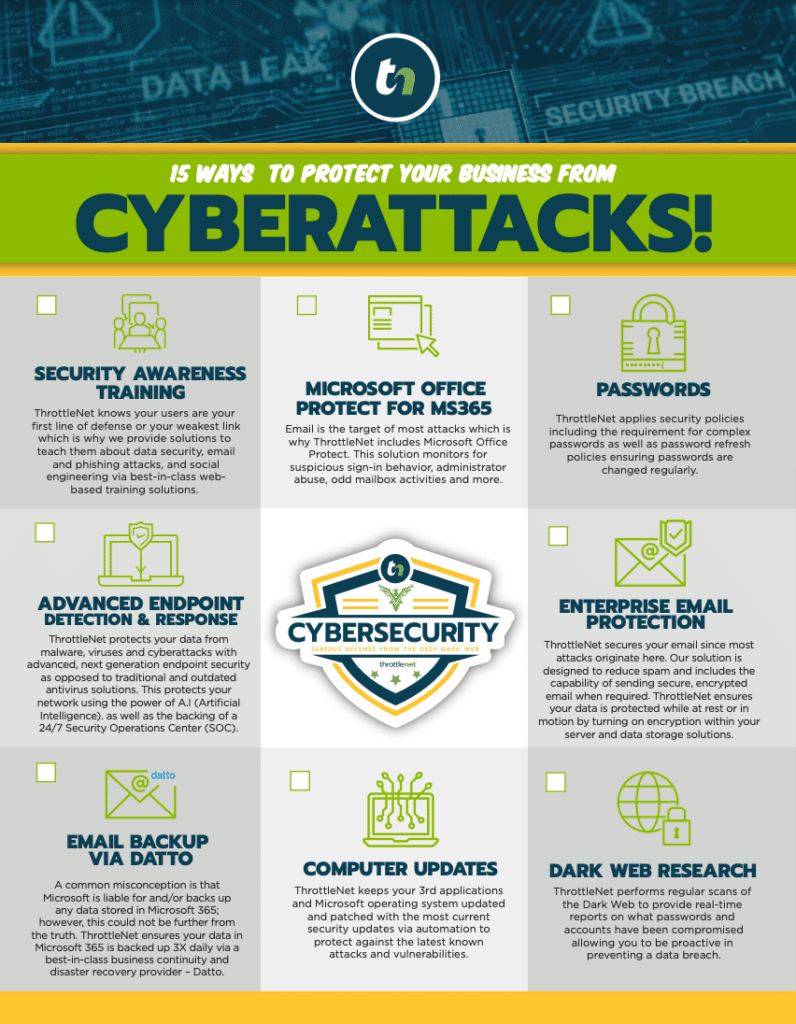
- Local Threat Intelligence: At ThrottleNet, our 24/7 Security Operations Center (SOC) doesn’t just look at global trends; we monitor regional threat intelligence. If we see a localized scam targeting St. Louis manufacturers, our dedicated cybersecurity team proactively adjusts our defensive posture to protect all our local clients before the scam even reaches them.
Building a Human Firewall: Your Action Plan
Technology is your first line of defense, but your employees are your last. Creating a “human firewall” is the most effective way to prevent localized phishing and BEC attempts from causing devastating financial loss.
Here is a practical checklist for St. Louis business leaders:
- Implement Multi-Factor Authentication (MFA): This is non-negotiable. If an employee accidentally gives away their password via a fake pizza receipt, MFA ensures the hacker still cannot access your network without the secondary approval on the employee’s phone.
- Establish Out-of-Band Verification: Create a strict company policy that any changes to vendor payment information, payroll routing, or wire transfers must be verified through a secondary communication channel. If the request comes via email, verify it via a known phone number.
- Deploy Continuous End-User Training: Cybersecurity isn’t a once-a-year presentation. It requires continuous, bite-sized education. ThrottleNet integrates end-user security awareness training directly into our TN TechHub—a centralized IT command center—so employees learn to spot the exact types of localized lures targeting Midwest businesses today.
Frequently Asked Questions (FAQ)
What is the difference between BEC and EAC?
While BEC (Business Email Compromise) is the act of impersonating an employee or vendor, EAC (Email Account Compromise) is when a hacker actually takes over a legitimate employee’s inbox. Phishing is often the tool used to achieve EAC, which then allows the hacker to launch highly convincing BEC attacks from the inside.
Why do my employees keep falling for scams when we already have a spam filter?
Because generic filters look for malicious code, not malicious intent. A plain-text email asking an employee to buy Apple gift cards for a “client appreciation event” contains no viruses, so a basic filter lets it through. This requires advanced email protection and behavioral AI to catch.
What should an employee do if they realize they clicked a localized phishing link?
First, foster a culture where employees aren’t afraid to report mistakes. The faster IT knows, the faster they can isolate the threat. They should immediately disconnect from the network, notify their IT support team, and change their passwords using a secure, uncompromised device.
How does ThrottleNet protect against these specific threats?
ThrottleNet doesn’t rely on a “break-fix” approach or small teams of generalists. We use a multi-tiered help desk backed by specialist teams in cybersecurity and cloud services. Our industry-leading 90-second average response time and 93% same-day resolution rate mean that if a threat is detected, it is addressed instantly. Furthermore, we back our layered defense with a $500,000 cybersecurity protection program—giving you total peace of mind against ransomware and business email compromise.
Ready to Secure Your St. Louis Business?
Navigating the landscape of localized cyber threats doesn’t have to be a burden you carry alone. The most secure businesses don’t just react to threats; they proactively align their technology, their training, and their strategies.
If you’re unsure whether your current email protection can withstand a targeted local attack, it’s time to find out. As the most reviewed and trusted managed IT provider in the region—with over 750 five-star Google reviews—ThrottleNet is here to help.
Start by booking a Free On-Site Assessment & Security Report. We’ll help you uncover your vulnerabilities, educate your team, and build a technology roadmap that keeps your operations fast, seamless, and completely secure.