
Imagine this scenario: It’s 10:30 AM on a Tuesday. Your production floor in Chesterfield is humming along perfectly. Orders are being filled, the CNC machines are communicating with the design server, and your logistics software is printing shipping labels.
Then, silence.
A network switch fails. Or perhaps a legacy server, the one everyone has been afraid to touch for years, finally gives up the ghost. Suddenly, your “humming” factory becomes a silent, expensive room of stationary machinery and idle employees.
For many plant managers and business owners, this isn’t a hypothetical nightmare—it’s a Tuesday reality. In the high-stakes world of manufacturing, IT isn’t just about sending emails; it’s about keeping the assembly line moving.
If you are exploring how technology impacts your bottom line, you aren’t alone. This guide breaks down the specific IT challenges facing manufacturing businesses in our region and explains how the right support structure transforms technology from a bottleneck into a competitive advantage.
The Real Cost of “Doing Nothing”
When we talk about downtime, we often think about the frustration of the moment. But let’s look at the math.
Research indicates that the cost of downtime in manufacturing is rising sharply. It’s not just about the lost revenue from products that weren’t made during the outage. The true cost includes:
- Idle Labor: Paying skilled workers to stand and wait.
- Catch-up Costs: Overtime pay required to make up for lost hours.
- Reputation Damage: Missed delivery windows that frustrate clients.
- Recovery Expenses: The emergency fees paid to fix the immediate problem.
The “Aha” Moment: Consider a local manufacturer who experienced a critical failure lasting 72 hours. Between lost production, emergency remediation, and data recovery, the cost exceeded $250,000. Once they implemented a proactive, specialized IT strategy, subsequent incidents were caught early, resolved remotely, and cost less than $5,000 to manage.
The difference wasn’t the machinery; it was the strategy behind the screen.
The Two Halves of Your Factory’s Brain: IT vs. OT
One of the biggest sources of confusion—and frustration—for manufacturing leaders is the disconnect between the office and the production floor. To solve downtime, you have to understand the difference between IT and OT.
Information Technology (IT)
Think of this as your company’s “Central Nervous System.” It handles data.
- Email and communication (Microsoft 365, Teams)
- Financial systems and ERPs (Enterprise Resource Planning)
- Customer data and inventory logs
- Cloud storage and backups
Operational Technology (OT)
Think of this as your company’s “Muscular System.” It handles the physical world.
- SCADA systems (Supervisory Control and Data Acquisition)
- PLCs (Programmable Logic Controllers) on the assembly line
- Industrial sensors and robotics
- Manufacturing Execution Systems (MES)
The Problem: Many businesses hire a generalist IT provider or rely on a “jack-of-all-trades” internal employee. While they may be excellent at fixing Outlook or resetting passwords (IT), they often lack the specialized knowledge to troubleshoot why a specific machine isn’t talking to the network (OT).
When these two systems don’t talk to each other securely and efficiently, production stops. Effective support requires a team that understands the convergence of both.
Common IT Blind Spots on the Production Floor
In Chesterfield and the greater St. Louis area, we see specific patterns that lead to preventable downtime. If you recognize these in your own facility, you have identified an opportunity for improvement.
1. The “Legacy” Trap
Manufacturing equipment is built to last 10, 20, or 30 years. IT equipment is usually obsolete in five. This creates a dangerous gap where modern networks try to communicate with Windows XP-era controllers. Without specialized support to bridge this gap, these legacy systems become ticking time bombs for security breaches and failure.
2. The Ransomware Target
There is a misconception that hackers only target banks or hospitals. In reality, manufacturers are top targets because hackers know you cannot afford downtime. They gamble that you will pay the ransom quickly just to get the machines running again.
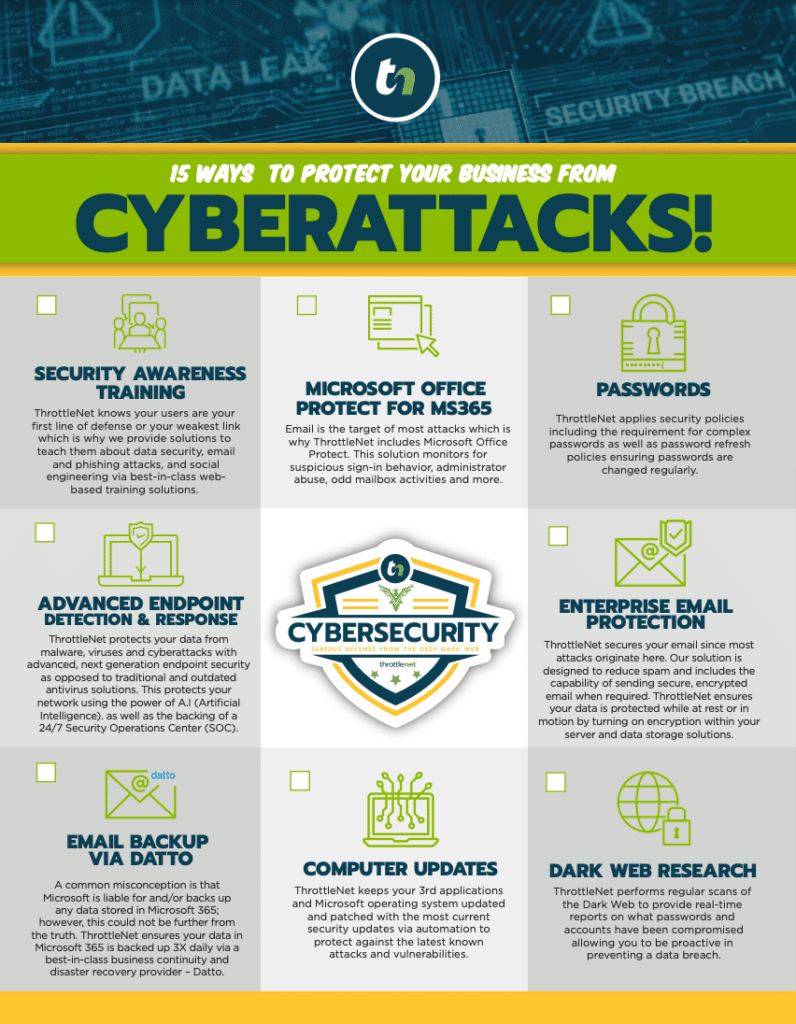
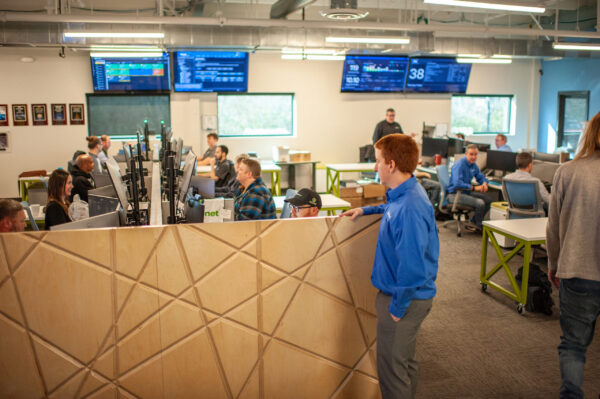
- Fact: A robust defense requires more than just antivirus. It needs 24/7 Security Operations Center (SOC) monitoring to detect threats before they lock your files.
3. The “Generalist” Bottleneck
If your IT support relies on a single person or a small, generalist team, you are vulnerable to their bandwidth. If they are busy fixing a printer in the front office, your production line problem waits.
- The Solution: A multi-tiered help desk. This ensures simple problems go to Tier 1, while complex engineering issues are elevated to Tier 2 and Tier 3 experts. This structure is the secret behind achieving a 90-second average response time when using our chat feature.
Why Speed and Location Matter
In the digital age, we often hear that “location doesn’t matter.” But when a server goes down in Chesterfield, do you want support from a call center in another time zone, or a team that can be on-site if remote tools fail?
The 90-Second Standard
In manufacturing, every minute of downtime bleeds profit. The industry standard for response time can often be hours. However, ThrottleNet pushed this down to a 90-second average response time with a 93% same-day resolution rate.
Achieving this requires a “deep bench” of talent—specialized teams for cybersecurity, cloud services, and strategy—rather than a single account manager trying to do it all.
Moving from “Break-Fix” to Strategic Growth
The ultimate goal of Top-of-the-Funnel education is to help you see your technology differently.
Most manufacturers operate in a “Break-Fix” model: The machine breaks, we call IT, they fix it, we pay the bill. This is the most expensive way to manage technology because you are paying for the downtime plus the repair.
The shift you should be looking for is toward Managed IT Services with a vCIO (Virtual Chief Information Officer).
A vCIO doesn’t just fix computers; they look at your business roadmap. They ask questions like:
- “How can we budget for server upgrades so we aren’t hit with a surprise $20k expense next year?”
- “How can we use AI automation to streamline the data entry between the shop floor and the finance office?”
- “Is our backup strategy capable of restoring our ERP in hours, not days?”
By aligning your IT strategy with your production goals, you stop paying to fix problems and start investing in efficiency.
Frequently Asked Questions (FAQ)
Q: Can’t my internal IT manager handle our manufacturing support?
A: Your internal IT manager is likely a hero who is overworked. They are often bogged down by daily help-desk tickets (password resets, printer jams). Co-Managed IT services can partner with your internal staff, offloading the 24/7 monitoring and cybersecurity heavy lifting so your internal lead can focus on strategic production projects.
Q: Is cloud computing safe for manufacturing data?
A: Yes, if configured correctly. Cloud solutions (like Microsoft Azure) often offer higher security standards than an on-premise server sitting in a dusty, unlocked closet. However, it requires a dedicated cloud engineering team to secure the environment properly.
Q: What is the biggest cybersecurity risk for manufacturers right now?
A: Ransomware remains the top threat. It often enters via email (phishing) but spreads to the production network. Ensuring you have an IT partner that offers a substantial financial guarantee (such as ThrottleNet’s $500,000 cybersecurity protection program) shows they are confident in their ability to protect you.
Understanding the risks of downtime and the difference between IT and OT is the first step toward a more resilient business.
If you are curious about how your current operational resilience stacks up against industry standards, seeking an educational assessment is a great place to start. Knowledge is the best tool you have to keep the production floor running smooth, secure, and profitable.