
If you’ve ever Googled what to look for in a managed services provider, you’re probably not looking for another vague list of “we do IT.” You’re looking for clarity: what actually matters, what questions to ask, and how to choose an IT partner that won’t disappear the moment something breaks.
In the St. Louis and greater Midwest market, the right MSP should feel less like a vendor and more like an extension of your leadership team: proactive, security-minded, responsive, and accountable.
Below is why ThrottleNet is built around these exact standards; and a practical guide to what to look for in a managed services provider when you’re making the decision.

1) Real responsiveness
Downtime isn’t just annoying, it’s expensive. When your internet is down, a server is acting up, or email access suddenly fails, speed matters. A managed services provider should be able to show you:
- How quickly they respond
- How they track response and satisfaction
- How support is delivered (phone, portal, email, desktop shortcut, etc.)
- Whether they have the depth to handle both quick fixes and complex issues
At ThrottleNet, we’re built for speed and clarity. Our multi-tiered help desk model routes requests to the right level quickly (instead of making you wait in a one-size-fits-all queue). We also put our numbers front and center: we average an under-2-minute response time and publish customer satisfaction metrics from Customer Thermometer right on our website because you shouldn’t have to “take our word for it.”
What to ask any MSP:
- What is your average response time?
- How do you measure customer satisfaction?
- What happens if my issue is urgent after hours?
2) Security that’s built in
A modern MSP has to be a cybersecurity partner. If “security” is listed as an add-on, that’s a red flag and it’s a key point in what to look for in a managed services provider.
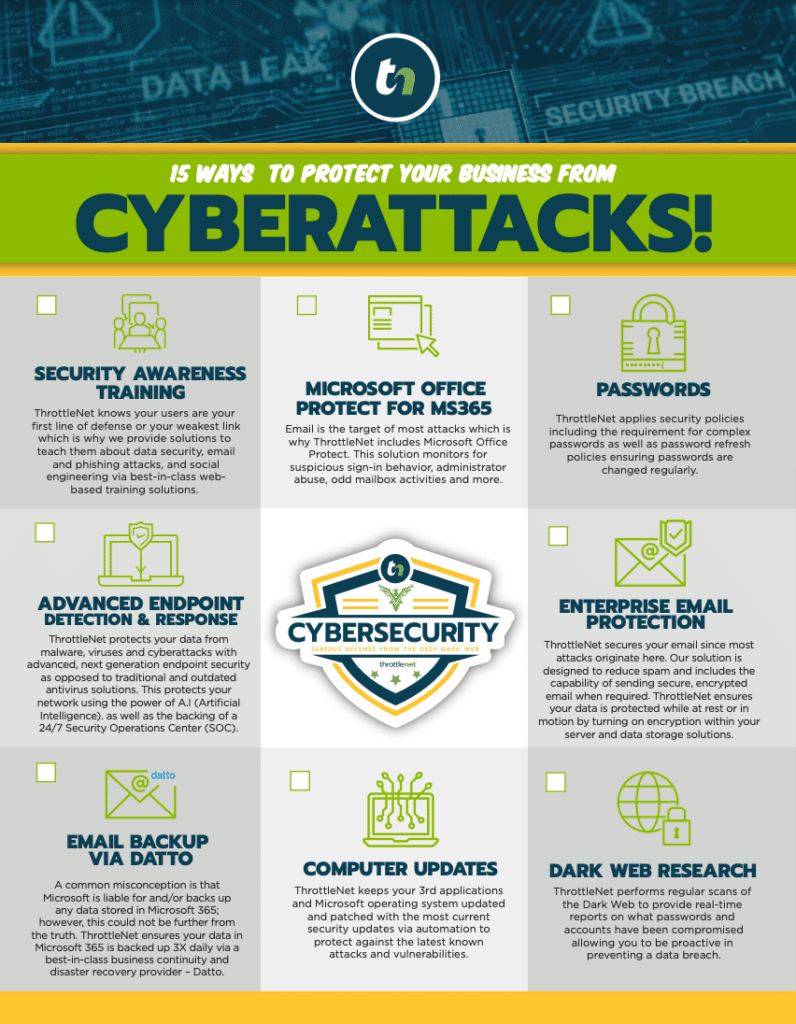
A strong MSP should provide a layered approach that includes:
- Endpoint protection + monitoring
- Email security + identity protections
- Ongoing patching/maintenance
- Security awareness training for users
- Clear standards and a framework (so you know it’s not random)
At ThrottleNet, we follow a NIST-based cybersecurity framework because security can’t be improvised. It gives us a consistent, proven way to protect, detect, respond, and recover so your business isn’t relying on luck when something goes wrong.
We back that framework with managed detection and response (MDR) and a 24/7 security operations center (SOC), because most small and mid-sized businesses shouldn’t have to staff round-the-clock security internally to get real protection.
What to ask any MSP:
- What framework do you follow (NIST, CIS, etc.)?
- Do you provide MDR and is there 24/7 SOC coverage?
- Who reviews alerts — tools only, or humans too?
3) Email protection that assumes your inbox is the front door
Most real-world incidents start with email: phishing, account takeover, malicious links, fake invoices, and impersonation attempts. So when you’re deciding what to look for in a managed services provider, email security should be a must-have.
A credible MSP should cover:
- Spam/phishing filtering
- Suspicious sign-in monitoring (especially for Microsoft 365)
- Encryption
- Email backups/retention
- Training + phishing simulations
That’s why we treat email like the front door. We provide multi-layer email security for Microsoft 365: monitoring, spam and phishing filtering, encryption when needed, backups, plus end-user training and mock phishing simulations.
What to ask any MSP:
- What do you do to protect Microsoft 365 logins and admin activity?
- Do you run phishing simulations and training?
- If a mailbox is compromised, what’s the response plan?
4) Backups and disaster recovery you can trust under pressure
Backups only matter when everything is on fire. And in those moments, “we think it’s backed up” is not a strategy. This is another core checkpoint in what to look for in a managed services provider.
A strong MSP should be able to answer:
- How often do backups run?
- Are backups isolated from ransomware?
- How fast can we restore (RTO)?
- How much can we afford to lose (RPO)?
- Have restores been tested?
We build backup and disaster recovery around real business outcomes; clear recovery objectives (RTO/RPO), practical planning, and options that fit your environment (local + cloud). The goal isn’t “having backups.” The goal is being able to recover fast and keep operating when pressure is highest.
What to ask any MSP:
- How do you verify backups are actually recoverable?
- Can we keep operating if a server is down?
5) Strategy and leadership
A lot of MSPs will happily fix issues all day long… while your business slowly accumulates tech debt, shadow IT, and security gaps. If you’re weighing what to look for in a managed services provider, make sure strategy is part of the package instead of an afterthought.
The best MSPs help you plan:
- Technology roadmaps
- Budgeting and lifecycle replacement plans
- Risk management and security priorities
- Growth planning (new locations, new users, new tools)
- Business alignment (technology that supports goals)
We pair our clients with a dedicated vCIO strategist because strong IT isn’t just support, it’s planning. You get help shaping roadmaps, budgets, lifecycle replacements, and security priorities so technology stays aligned with where your business is going.
What to ask any MSP:
- Who helps us plan the roadmap and budget?
- How often do we review strategy?
- Do you provide guidance on risk and compliance?
6) A “local and accountable” operating model (especially in St. Louis)
As you think through what to look for in a managed services provider, confirm your MSP is truly supporting St. Louis and the surrounding Midwest region. They should understand the realities of local businesses: multi-site growth, mixed environments, Midwest compliance demands, and the need for real people who pick up the phone.
We’re a veteran-owned provider based right here in the St. Louis area, and we’re intentional about serving this region. That matters because local businesses need an MSP that can shows up when needed, understands how Midwest companies operate, and stays accountable long after onboarding.
What to ask any MSP:
- Where is your support team located?
- Do you offer onsite support when needed?
Why pick ThrottleNet?
The decision often comes down to one question:
Do you want an MSP that simply reacts… or a partner that prevents problems, hardens security, and helps you plan what’s next?
Here’s what it comes down to: we’re built to be proactive, not reactive. ThrottleNet is designed around fast response, security-first operations, and strategic guidance through vCIO support, plus the day-to-day coverage businesses need across IT support, consulting, user/email protection, network security, backups, and cybersecurity.
And we don’t hide behind vague promises. We publish measurable service metrics, like response time and customer satisfaction, so you can evaluate us based on performance, not marketing language. If you’re still deciding what to look for in a managed services provider, transparency like that is a great test.
A simple “MSP evaluation” scorecard you can use today
When comparing providers, give each category a score from 1–5:
- Responsiveness & support depth
- Security framework + 24/7 monitoring
- Microsoft 365 + email protection
- Backups + disaster recovery confidence
- Strategic planning (vCIO / roadmap/budgeting)
- Local accountability + onsite capability
- Standards, documentation, and ownership
If an MSP can’t clearly explain how they deliver (and prove) these, keep looking.
And if you’re still working through what to look for in a managed services provider, that’s exactly what a good consultation should help you clarify without pressure, without jargon, and with a clear plan forward.
Ready to sanity-check your current IT setup?
If you’re still wondering what to look for in a managed services provider or you’re ready to upgrade from “it mostly works” to a more secure, proactive model, schedule a consultation today!
(We’ll help you identify gaps, prioritize fixes, and map out what “good IT” should look like for your St. Louis business.)

Jeremiah Jeffers
Business Development Assistant
[email protected]