IT Business Continuity: Why Downtime Is Not an Option
When it comes to IT business continuity, there’s simply no time for downtime. Without a reliable security and recovery plan, even the most advanced IT systems can be brought to a standstill. Cybercriminals use sophisticated tools to scan the internet, looking for vulnerabilities to exploit. As businesses increasingly rely on remote teams and hybrid work models, the digital landscape has become a hotbed for opportunity — not for innovation, but for attack.
Cyber-criminals don’t discriminate. Anyone can be a target. Whether you’re a small nonprofit, a growing local business, or an established enterprise, if your organization relies on technology (and whose doesn’t?), IT business continuity should be your top priority.
“Thanks to the knowledgeable support team at ThrottleNet, our network is running faster and more efficiently than ever before.” – Dr. Richard Goldberg
Building a Smart IT Security Strategy
Having a strong IT business continuity plan doesn’t mean locking every file behind retina scans or overcomplicating workflows. It’s about finding the right blend of tools, training, and policies that align with your operations. Often, continuity and security simply require following best practices, keeping your software up to date, and ensuring your staff are aware of evolving cyber threats.
You’re in the business of staying in business. Do you have a continuity plan that includes security? Imagine not having access to your data or servers for a day—or a week. What if ransomware locked your critical files, demanding payment in cryptocurrency? Would your company survive the downtime?
According to the Ponemon Institute, small businesses spend an average of $690,000 recovering from cyberattacks, while mid-sized companies spend over $1 million. Few can absorb that kind of loss, especially in an unpredictable economy. The first step to effective IT business continuity is prevention — and your weakest link is often your people. Proper training can turn employees into your strongest defense.
The Three Keys to IT Business Continuity
1. Prevention
Educate your team on cybersecurity best practices and make ongoing training part of your continuity culture.
2. Protection
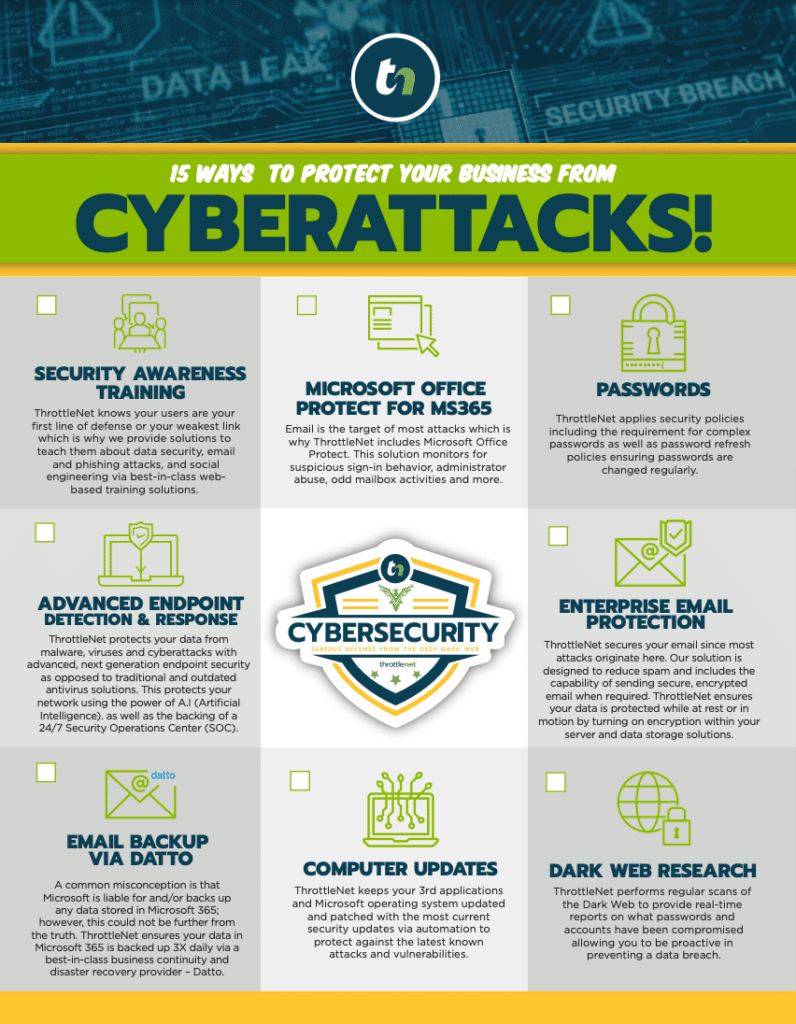
Even if you’re targeted, you don’t have to be breached. A proactive defense plan should include:
Firewalls
Offsite backups with cloud replication
Threat monitoring
Virus/malware/adware detection and removal
Software patch management
Heuristic threat detection tools
3. Planning
The final piece of IT business continuity is preparedness. Businesses that survive cyber incidents are those with tested, tech-driven recovery strategies. Modern solutions make it possible to restore systems, recover data, and resume operations quickly after an attack.
“ThrottleNet’s quick response and expertise has been crucial in supporting our infrastructure at RBO PrintLogistix.” – Jim Riley, CEO and President of RBO PrintLogistix
Backing up your data is important—but verifying those backups is critical. A compromised backup file offers no safety. The time to prepare is before a disaster occurs. Redundancy is resilience, and at ThrottleNet, we make sure your systems are secure, your backups are clean, and your business can withstand anything.
Final Thoughts
In today’s threat-heavy environment, IT business continuity is more than a strategy — it’s survival. From network monitoring to employee education, every step strengthens your resilience. With ThrottleNet as your partner, your business can stay protected, productive, and always online.
16 Ways to Protect Your St. Louis Business From Cyberattacks