
Industries at Risk for Cyber Attacks: Who Hackers Target and Why
Functional and secure IT has become vital in almost every industry. Businesses and organizations that handle sensitive information or have low technology budgets fall squarely into the bucket of industries at risk for cyber attacks. As digital operations and interactions become the norm, business leaders have to recognize the risks and take a proactive approach to cybersecurity. Identifying vulnerabilities is the first step toward enhanced security for organizations in industries at risk for cyber attacks.
The following isn’t an exhaustive list by any means — just about any organization can fall victim to a cyber attack. Still, our experience with cybersecurity has taught us that some industries are especially vulnerable. Hackers target businesses and other organizations they think are likely to have valuable, vulnerable information.
It’s always important to know the risks, especially if you work in any of the industries at risk for cyber attacks listed below.
Top Industries at Risk for Cyber Attacks
Manufacturing
Unplanned downtime will almost always damage the bottom line, and ransomware attacks are engineered to cause exactly that. Manufacturers sit on operational data, supplier contracts, and increasingly connected shop-floor equipment — all of which make them a natural fit among industries at risk for cyber attacks. The right partner helps you maximize efficiency and profits without excessive upfront investments, while protecting the systems that keep the plant running. Key priorities: eliminating costly downtime, reducing operating cost, and 24/7/365 support.
Healthcare
The stakes are high when health is on the line. Electronic health records, scheduling systems, and connected medical devices all represent attack surface — and the regulatory pressure around HIPAA makes a breach exponentially more expensive. Healthcare organizations need to protect patient privacy and provide superior care on secure, productive networks. Key priorities: HIPAA risk assessment, Business Associates Agreements, and disaster recovery.
Financial Services
Hackers like to target organizations that manage lots of money — a category that almost perfectly describes Financial services firms. Protecting your business while you protect your clients’ nest eggs requires layered defenses against phishing, fraud, and data exfiltration. Key priorities: phishing attack training, cloud-based backups, and a SOC 1 certified data center.
Legal
Lawyers work day and night, and are no strangers to confidentiality. Firms store case files, privileged communications, and client personally identifiable information — all high-value targets. Legal organizations need tireless support and complete discretion from their IT partner. Key priorities: protecting confidential information, help desk plus onsite support, and private network support.
Real Estate
Misplaced paperwork can halt Real Estate transactions in their tracks, and wire-fraud scams targeting title companies and brokerages have become one of the most expensive categories of loss in recent years. Agents need the tools — and the cybersecurity backbone — to keep closing deals without exposing clients. Key priorities: cloud collaboration and sharing, document versioning capabilities, and SOC 1 compliance.
Not-for-Profit
As disturbing as it is, some hackers specifically target not-for-profit organizations that don’t have the budgets for adequate cybersecurity. Not-for-Profit firms sit firmly among industries at risk for cyber attacks because donor data, financial information, and limited IT staffing combine into a tempting target. The right IT and security partner can address threats with affordable solutions to keep you focused on the mission. Key priorities: risk assessment technology, managed network and support, and procurement advice.
The Threat Is Evolving
Hackers are becoming more sophisticated, so ransomware and other cyber attacks are becoming more complex. The best method of defense is to know what you’re up against, but following trends and keeping up with technology is demanding work. Business leaders are realizing the need to educate themselves and their employees about different types of ransomware, phishing, and social engineering.
Even while taking proactive steps to increase cybersecurity, disaster recovery plans have proved to be critical. The cost of ransomware averages close to $100,000 per incident for small and mid-sized businesses, and ransom demands cost businesses in the United States billions of dollars each year in total. The effects can be devastating — and for organizations in industries at risk for cyber attacks, that’s not a hypothetical.
How to Reduce Your Risk
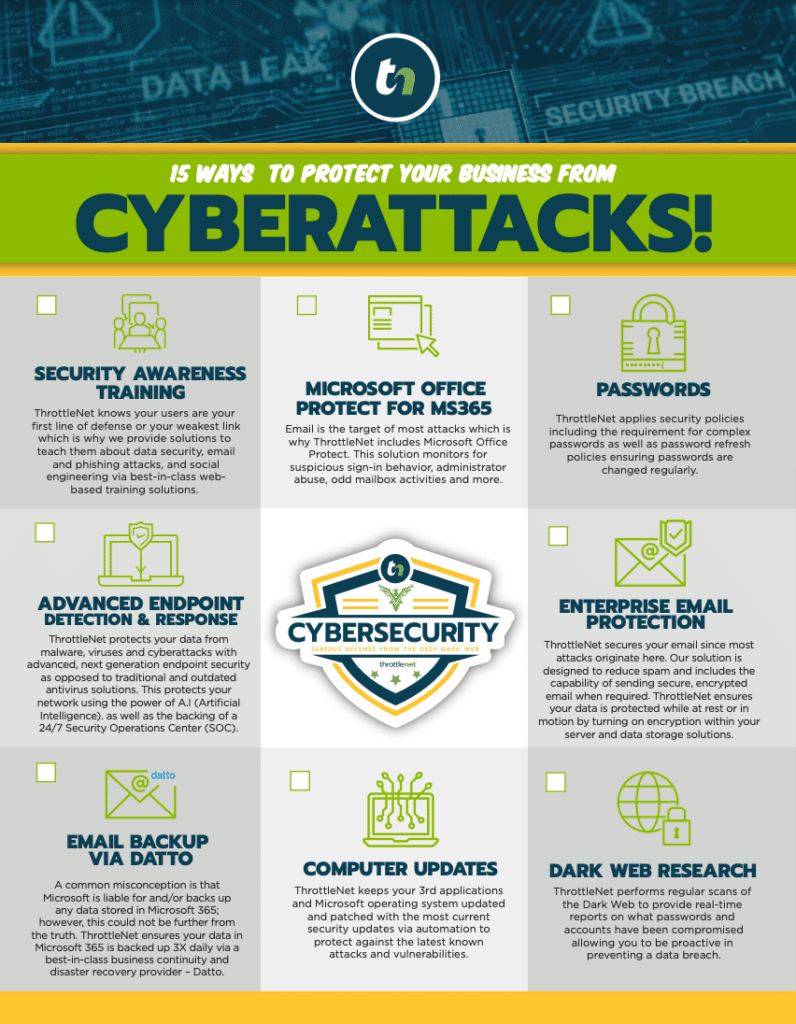
If your organization shows up on a list of industries at risk for cyber attacks, the smartest thing you can do is stop trying to DIY cybersecurity. Adopt a written security policy, run regular phishing simulations, require multi-factor authentication on every account, patch relentlessly, and back up your data to an offsite or cloud location that can’t be reached from your production network. Most importantly, have a disaster recovery plan that has been tested — not just written.
The businesses that recover fastest from an incident aren’t the ones that never got hit; they’re the ones that practiced what they’d do when they did.
Work with a Partner That Specializes in Your Risk Profile
In one of the industries at risk for cyber attacks? No need to stress about it. Contact ThrottleNet, and our team of cybersecurity experts will create a customized plan to keep your organization safe. We’re consistently rated among the best IT companies in St. Louis because of our focus on security. When you reach out to us, you’ll see why we’re the trusted MSP for organizations in industries at risk for cyber attacks. Business leaders are realizing the need to educate themselves and their employees about different types of ransomware.
Even while taking proactive steps to increase cybersecurity, disaster recovery plans have proved to be critical. The cost of ransomware averages close to 100,000. Ransom demands cost businesses in the United States billions of dollars each year in total, and the effects can be devastating. In one of the industries at risk for cyber attack? No need to stress about it! Contact ThrottleNet, and our team of cybersecurity experts will create a customized plan to keep your organization safe. We’re consistently rated among the best IT companies in St. Louis because of our focus on security. When you reach out to us, you’ll see why we’re the trusted MSP for organizations in industries at risk for cyber attacks.