
Regular data backups are one of the most effective defenses a business has against ransomware, yet far too few companies implement them correctly. Ransomware is being used with increasing frequency to extort money from computer users all over the world. It has become so prevalent, in fact, that it can now be found lurking in advertisements on many popular websites.

While ransomware infections are indiscriminate about who they target, the total cost of infection falls disproportionately on small businesses. This is because small businesses tend to have far more limited financial resources than larger enterprises, and they often lack the robust security infrastructure needed to protect against ransomware attacks. When budgets are tight, regular data backups become one of the highest-value, lowest-cost protections a small business can put in place.
When it comes to preventing the worst outcomes of ransomware infections, backups are among the most effective tools available. However, many businesses don’t take proper precautions when setting up backup systems for their computers — which means that when an attack hits, their safety net fails. Here’s what you should know about regular data backups and ransomware prevention.
The Rise of Ransomware
Ransomware has become an increasingly popular way to extort money from businesses and consumers alike. The FBI has reported thousands of complaints involving ransom demands through strains like CryptoLocker, with payments totaling millions of dollars — and those figures only capture the incidents that get reported. But what can you actually do to protect yourself?
A survey by ESET found that roughly 9% of Americans have been impacted by ransomware, yet only about 31% keep regular data backups in place to help minimize the risk if they’re ever hit with a malware attack such as ransomware or cryptoware. That gap is exactly why so many victims feel they have no choice but to pay. With regular data backups, you retain the option to restore your systems instead of negotiating with criminals.
How Can Businesses Prepare?
Even though more than 90% of businesses are eventually able to recover their data after a ransomware attack, recovery is never free. Financial, reputational, and operational costs are all part of the aftermath of a successful attack. The first step to protecting your business against ransomware is ensuring that you have effective, regular data backups in place — but backups are only as good as their implementation.
For example, it’s essential for businesses to follow the proven 3-2-1 rule: keep at least three copies of your data, stored on two different media types, with one copy kept off-site. You should also make sure your backups are set to update at least daily — and ideally more often — particularly if you store client or customer data on your network. Just as importantly, test your restores regularly; a backup you’ve never verified is not a backup you can rely on. Consistent, regular data backups paired with routine testing are what separate a minor disruption from a business-ending event.
Why Regular Backups Alone Aren’t Enough

Here’s the catch that catches many businesses off guard: regular data backups, on their own, are not always enough to defeat ransomware. The problem is timing. If your backup simply overwrites the previous copy each day, and ransomware has quietly encrypted or corrupted your files before that backup runs, you may end up backing up the damage — replacing your last clean copy with an infected one. Worse, modern ransomware often sits dormant for days or weeks before triggering, so a single rolling backup can be compromised long before anyone notices.
This is why versioned backups are essential. Instead of keeping just one current copy, versioning preserves multiple point-in-time recovery points — yesterday’s data, last week’s, last month’s — so you can roll back to a known-clean state from before the infection took hold. If an attack encrypts your files on Friday, version history lets you restore Thursday’s clean copy rather than discovering your only backup is already ransomed.
For the strongest protection, pair versioned, regular data backups with immutability. Immutable (or “write-once”) backups cannot be altered or deleted once written, even by an administrator account that’s been compromised. Combined with the off-site copy from the 3-2-1 rule, versioning and immutability turn your backups from a single fragile snapshot into a deep, tamper-proof safety net — which is exactly what ransomware recovery demands.
How IT Service Providers Can Help
An experienced IT service provider can help businesses find a backup solution tailored to their unique needs. This may include a mixture of on-site and off-site backups, as well as different media types — both physical and virtual. A provider can also help you implement immutable or air-gapped backups that ransomware can’t encrypt, adding another critical layer of protection.
IT service providers can also help businesses build a schedule for regular data backups that minimizes the risk of data loss in the event of a ransomware attack or other malware infection. Pairing that schedule with managed cybersecurity services gives your business both prevention and a reliable path to recovery.
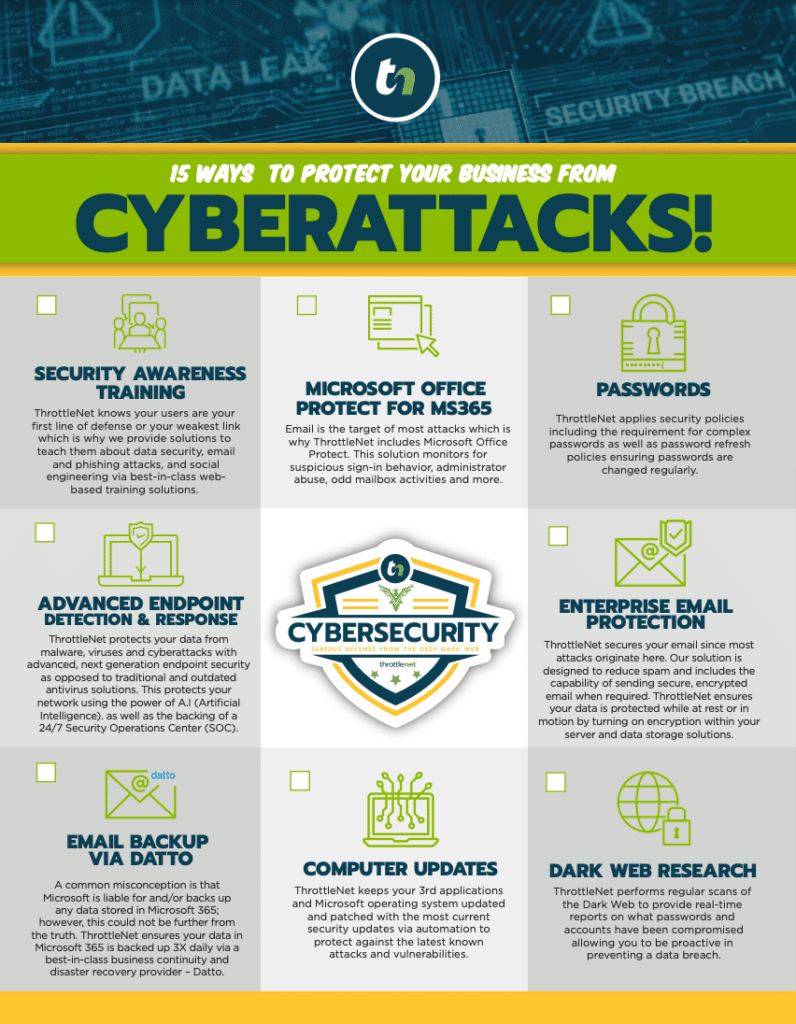
The most important step is creating a solid backup plan you can rely on when the worst happens. ThrottleNet can provide your business with a backup system — built on regular data backups and best-practice testing — that helps you recover quickly from a ransomware attack.
How ThrottleNet Can Help
Don’t wait until an attack forces the question. With the right strategy and consistent, regular data backups in place, your business can face ransomware from a position of strength rather than desperation.
To find out more about business data backups and ransomware prevention, contact us today for a free consultation.