
It is 2:00 PM on a Tuesday. Your production floor is humming, orders are being filled, and your logistics team is preparing shipments for a key client in St. Louis. Suddenly, a primary CNC machine goes silent. Then the inventory management system freezes.
The floor manager checks the mechanics—the machine is fine. The problem is digital.
For manufacturing leaders in O’Fallon, this scenario is the stuff of nightmares. In an industry where margins are tight and delivery windows are tighter, technology is no longer just a back-office utility; it is the central nervous system of your production line.
If you are a CFO or Owner of a manufacturing firm, you likely view downtime as a mechanical issue. However, as factories move toward Industry 4.0, the root cause of halted production is increasingly technical. This guide explores the intersection of IT and manufacturing efficiency, helping you understand how to protect your uptime, secure your proprietary designs, and keep the line moving.

The True Cost of Silence: Why Every Second Matters
When a server crashes in a law firm, lawyers might be unable to file a brief for an hour. When a network crashes in a manufacturing plant, the cost is calculated in thousands of dollars per minute.
Research indicates that unplanned downtime costs industrial manufacturers an estimated $50 billion annually. But for a mid-sized operation in O’Fallon, the costs are more immediate:
- Idle Labor: Paying skilled workers to stand still.
- Missed Deadlines: Rush shipping fees to compensate for delays.
- Reputation Damage: The long-term cost of losing trust with your supply chain partners.
Many manufacturers still rely on a “break-fix” model for IT—calling for help only when something breaks. In today’s high-speed environment, waiting hours (or days) for a technician to arrive is a business risk you cannot afford.
The Mathematics of Recovery
Consider the difference between a standard IT response and a specialized rapid response.
- The Industry Average: It often takes 4 to 8 hours just to acknowledge a critical ticket, followed by potential days of troubleshooting.
- The High-Performance Standard: Best-in-class support providers, like ThrottleNet, average a 90-second chat response time and resolve 93% of all issues on the same day.
In manufacturing, that difference isn’t just convenient; it is the difference between a minor hiccup and a missed shipment.
The Invisible Culprits: 5 IT Vulnerabilities Stopping Production
You perform preventative maintenance on your physical machinery, but are you doing the same for your digital infrastructure? Here are the five most common IT vulnerabilities that lead to production stoppages.
1. The Collision of IT and OT
Operational Technology (OT)—the hardware and software that detects or causes changes in industrial processes—was once air-gapped (physically isolated) from the internet. Today, machines are connected to the network for data collection and remote monitoring. If your office network (IT) isn’t properly segmented from your factory floor network (OT), a simple phishing email opened in accounting can infect the software running your assembly line.
2. Legacy Hardware Bottlenecks
Many factories run mission-critical software on aging servers or operating systems (like Windows 7 or even XP) because “that’s what the machine requires.” These legacy systems are unstable and serve as open doors for cyber threats.
3. “Shadow IT” on the Shop Floor
When production managers download unauthorized software or connect personal devices to the Wi-Fi to “get the job done faster,” they bypass security protocols. This creates blind spots that your internal IT team cannot see until it causes a crash.
4. Ransomware Targeting Intellectual Property
Manufacturers are a top target for ransomware, not just for financial extortion, but for the theft of proprietary blueprints and formulas. A breach doesn’t just stop production; it compromises your competitive advantage.
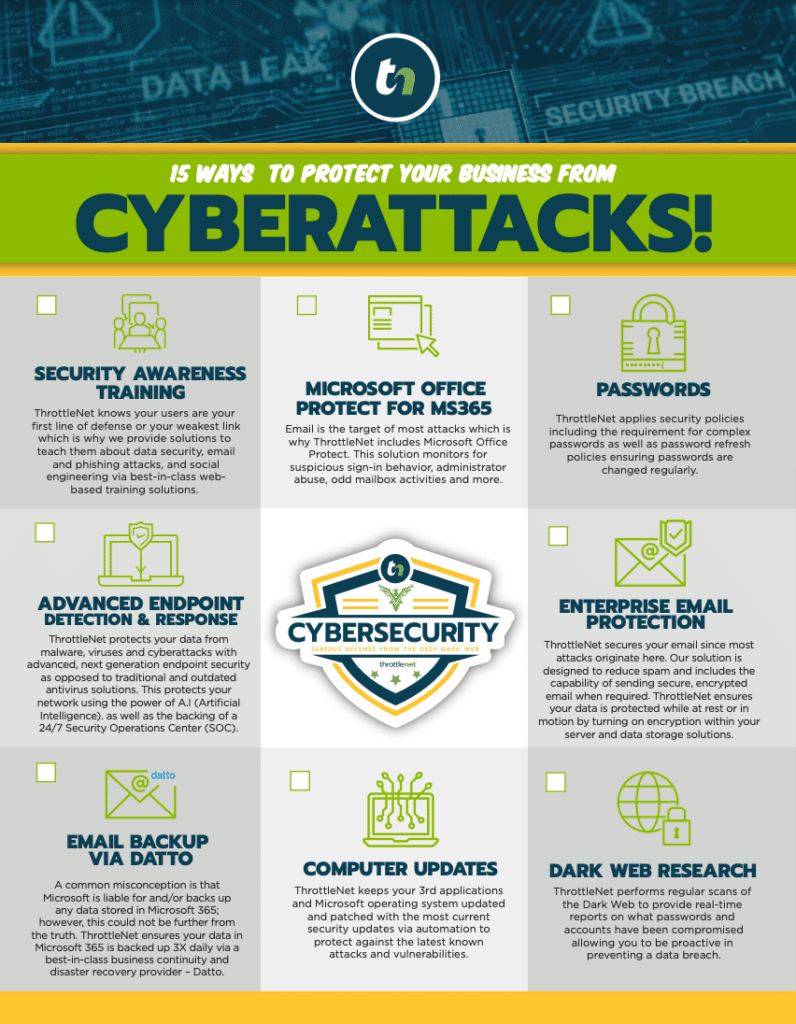
- Note: Real security goes beyond a firewall. It requires a layered approach backed by guarantees, such as ThrottleNet’s $500,000 Cybersecurity Protection Program, which ensures that defenses are tested and validated.
5. Lack of a “Digital Undo Button”
If a server fails or a file is corrupted, how fast can you restore operations? Many businesses have backups, but few test them. A robust Business Continuity and Disaster Recovery (BCDR) plan ensures you can spin up a virtual version of your server in minutes, not days.
Reactive vs. Proactive: A Tale of Two Factories
To understand the value of strategic IT support, it helps to compare two approaches to technology management.
Factory A: The Reactive Approach (The Firefighters)
Factory A relies on an internal “IT guy” or a generalist MSP. They view IT as a cost center to be minimized.
- The Process: When a network switch fails, production stops. They call IT. They wait. The technician arrives, diagnoses the issue, orders a part, and returns the next day to install it.
- The Result: Unpredictable costs, high stress, and significant production losses.
Factory B: The Managed Services Approach (The Architects)
Factory B partners with a specialized Managed Services Provider (MSP) that utilizes a Virtual CIO (vCIO) for strategic planning.
- The Process: 24/7 monitoring software detects unusual latency in the network switch before it fails. The MSP’s engineers remotely optimize the traffic or dispatch a replacement unit during a scheduled maintenance window.
- The Result: Continuous uptime, predictable budgeting, and a focus on growth rather than repair.
Why Local Support Matters for O’Fallon Manufacturers
While cloud technology allows for remote support, geography still matters in manufacturing. O’Fallon serves as a critical industrial hub for the St. Louis region.
Partnering with a provider who understands the local landscape offers distinct advantages:
- On-Site Presence: When a physical server goes down, you need boots on the ground immediately, not a remote technician in a different time zone.
- Vendor Management: A local partner can coordinate with your internet service providers (ISPs) and specialized machinery vendors effectively, speaking the technical language necessary to resolve disputes quickly.
- Regional Compliance: Understanding specific Midwest compliance requirements and supply chain standards is easier for a partner embedded in the community.
Beyond the Fix: Strategic IT Consulting (vCIO)
Perhaps the most overlooked aspect of IT support is strategy. A Virtual Chief Information Officer (vCIO) is not a repair technician; they are a business strategist who speaks technology.
For a manufacturing firm, a vCIO helps answer critical questions:
- “How do we budget for replacing our ERP system next year?”
- “Are we compliant with the latest NIST standards required by our defense contracts?”
- “Can we automate our inventory tracking to reduce human error?”
By having a dedicated vCIO, you move from reacting to problems to planning for profitability.
FAQ: Common Questions from Manufacturing Leaders
What is the difference between IT and OT security?
IT (Information Technology) deals with data—emails, ERPs, and financial records. OT (Operational Technology) deals with the physical machines—CNCs, PLCs, and SCADA systems. Securing OT requires specialized knowledge because you cannot simply “reboot” a factory floor the way you reboot a laptop.
Can’t we just use antivirus software?
No. Antivirus is reactive; it catches known threats. Modern manufacturing security requires a Security Operations Center (SOC) that monitors for suspicious behavior 24/7, along with Endpoint Detection and Response (EDR) tools that can isolate an infected machine instantly to save the rest of the network.
We have an internal IT manager. Why do we need an MSP?
This is known as Co-Managed IT. Your internal manager is likely overwhelmed with daily helpdesk tickets (password resets, printer jams). A partner like ThrottleNet can handle the heavy lifting—cybersecurity, backups, and 24/7 monitoring—freeing your internal lead to focus on proprietary software and process improvements.
How do we calculate the ROI of Managed IT?
Start by calculating your downtime cost. If your line generates $5,000 of product per hour, preventing just 10 hours of downtime a year saves you $50,000. Add in the reduction of risk regarding ransomware (which costs an average of $1.85 million to remediate), and the ROI becomes clear.
The Next Step: Assessing Your Operational Health
You wouldn’t run a machine without checking its gauges, and you shouldn’t run your business without assessing your network health.
The first step toward eliminating downtime isn’t buying new software—it’s understanding where you are vulnerable. Whether you are struggling with slow networks, worried about ransomware, or just tired of waiting hours for support, the solution begins with a conversation.
Knowledge is power. By understanding the link between IT infrastructure and production efficiency, you are already ahead of the competition. Keep your systems running, your data safe, and your focus where it belongs: on the production floor.