
Imagine it is 4:15 PM on a Thursday. You have a hard filing deadline at 5:00 PM for a critical motion. You go to export the final PDF, and suddenly—your screen freezes. The server is completely unresponsive. You call your IT guy, get sent straight to voicemail, and are forced into a frantic scramble to find a workaround.
If you work in a law firm, your pulse probably just jumped a little.
For law firms in Washington, MO, and across the Midwest, technology isn’t just a background utility. It is the engine that drives billable hours and the vault that protects client trust. Yet, many managing partners and firm administrators still view IT as a necessary operational expense rather than a strategic tool for revenue protection.
Whether you are trying to understand if outsourcing your IT is normal for your firm’s size, or you are deeply concerned about the rising threat of ransomware, you are in the right place. Let’s explore the mechanics of “Response Time Economics,” the ethical realities of data security, and exactly what top-tier Managed IT should look like for your practice.
The Hidden Cost of “Break-Fix” IT (And the Billable Hour Math)
To understand Managed IT, we first have to look at its predecessor: the “Break-Fix” model.
In a break-fix relationship, you wait for something to break, call your IT person, and pay them an hourly rate to fix it. While this sounds logical on the surface, it creates a massive conflict of interest. A break-fix provider actually makes money when your firm experiences downtime.
Managed IT completely flips this model. By partnering with a Managed Service Provider (MSP), your firm pays a predictable monthly rate for comprehensive, proactive support. The MSP’s goal is to keep your systems running flawlessly because they lose money if they have to constantly send technicians to fix broken servers.
The Math Behind Response Time Economics
Let’s calculate your firm’s true cost of downtime.
Imagine you have five attorneys billing at an average of $300 an hour. A server outage takes your document management system offline for just two hours while a traditional IT provider scrambles to figure out the issue.
- 5 attorneys x $300/hour x 2 hours = $3,000 in lost revenue.
Now, apply “Response Time Economics.” What if your IT provider had a multi-tiered help desk with an average response time of just 90 seconds? That same issue is addressed before it escalates, turning a potential $3,000 loss into a brief, 12-minute ($12.50) hiccup.
When your IT responds instantly, your billable hours remain intact.
Legal-Specific IT vs. General Business IT
One of the biggest mistakes a law firm can make is hiring a generalist IT provider.
General business IT operates on a standard timeline. If a manufacturing company’s printer goes down, a 24-hour turnaround on a support ticket is usually acceptable. General IT says: “Submit a ticket, we’ll look at the server tomorrow.”
Legal IT says: “We know you have a filing deadline at 5 PM; we are remoting in right now.”
Law firms use highly specific software ecosystems—like Clio, iManage, or LexisNexis. They also have zero tolerance for downtime during business hours. A premier managed IT partner understands this dynamic.
Why Specialist Teams Matter
Most traditional MSPs rely on small groups of “generalist” technicians who juggle everything from password resets to complex server migrations. This creates bottlenecks.
At ThrottleNet, we engineered a different approach. We utilize a unique multi-tiered help desk paired with dedicated specialist teams.
- Tier 1 handles fast triage and rapid fixes.
- Tier 2 & 3 handle deep troubleshooting and advanced infrastructure.
- Specialist Teams focus entirely on distinct disciplines: Cybersecurity, Cloud Services, and IT Strategy.
Because your issue is instantly routed to the exact specialist equipped to solve it, ThrottleNet consistently achieves an industry-leading 90-second average response time and a 93% same-day resolution rate. Problems are simply solved faster, correctly, the first time.
The Fortress: Safeguarding Client Data and Ethical Compliance
Under the Missouri Rules of Professional Conduct (specifically Rule 4-1.6 concerning the confidentiality of information), lawyers have an ethical duty to make reasonable efforts to prevent the inadvertent or unauthorized disclosure of client information.
In today’s digital landscape, a locked filing cabinet is no longer enough. Law firms are high-value targets for cybercriminals because of the sensitive financial data, intellectual property, and personal information they hold.
The Anatomy of Law Firm Cybersecurity
Many firms assume that because they use cloud-based software, their data is automatically safe from ransomware. This is a dangerous misconception. If a paralegal clicks a malicious link in a phishing email, ransomware can encrypt their local machine and spread through your network, holding your case files hostage.
True cybersecurity requires a multi-layered fortress approach:
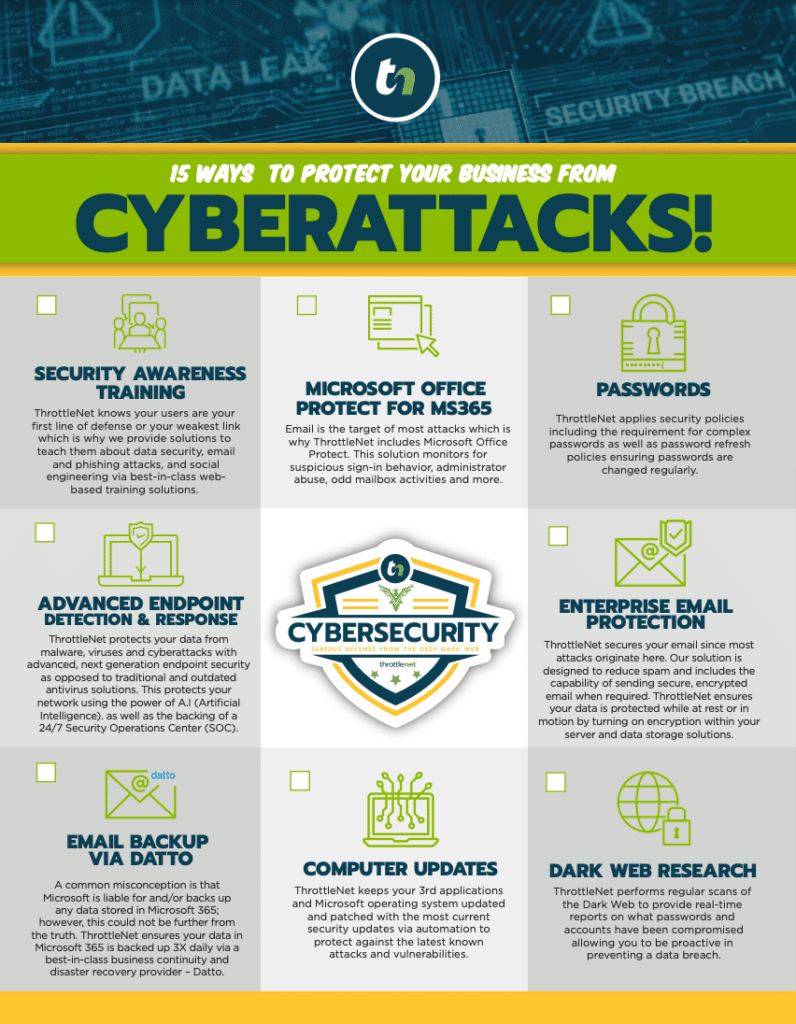
- Next-Generation Endpoint Security: Moving beyond traditional antivirus to detect malicious behavior on computers before it executes.
- 24/7 Security Operations Center (SOC): A dedicated team monitoring your network around the clock for anomalous activity.
- Advanced Email Protection: Filtering out phishing attacks and Business Email Compromise (BEC) attempts before they reach your attorneys’ inboxes.
- Verified Backups & Disaster Recovery: Regularly testing backups to ensure that, in the worst-case scenario, your firm can restore data in hours, not weeks.
This layered approach is why ThrottleNet customers have never paid a ransomware attack. In fact, ThrottleNet is so confident in its security architecture that it backs clients with an exclusive $500,000 Cybersecurity Protection Program—covering ransomware, business email compromise, and downtime recovery expenses.
The Transition Blueprint: Upgrading IT Without the Downtime
If your current IT is slow or frustrating, why haven’t you switched? For most firms, the answer is fear. Managing partners are terrified that transitioning to a new IT provider will cause weeks of disruptions, misplaced passwords, and lost productivity.
A professional IT onboarding process should be entirely painless and happen mostly behind the scenes. Here is how a seamless transition works:
- Day 1 Deployment: Your new provider securely deploys 24/7 monitoring software and cybersecurity protections across your network without interrupting your staff.
- Information Gathering: Engineers map your network, document all crucial details, secure critical passwords, and organize vendor contacts.
- The Command Center: Tools like ThrottleNet’s TN TechHub are introduced, giving your staff an intuitive, single portal to track support tickets, access cybersecurity training, and monitor IT performance.
- Strategic Alignment: You are paired with a vCIO (Virtual Chief Information Officer). Unlike a standard “account manager,” a vCIO is a dedicated IT strategist who helps you map out compliance, budget for the future, and ensure your tech aligns with the firm’s growth goals.
Frequently Asked Questions About Law Firm IT
Do law firms need an internal IT department?
It depends on the size of the firm, but rarely is a fully internal team necessary. Most small to mid-sized firms (10-200 employees) benefit most from Fully Managed IT. If you already have an internal IT manager who is overwhelmed by daily help-desk tickets and cybersecurity demands, Co-Managed IT is the perfect solution. It supplements your internal team with a 24/7 help desk, a vCIO, and enterprise-grade security tools at a fraction of the cost of hiring more internal staff.
How does an IT provider help with regulatory compliance?
Your IT provider translates legal and ethical mandates into technical controls. If your state bar requires reasonable efforts to protect data, your MSP implements Multi-Factor Authentication (MFA), sets up encrypted email platforms, restricts data access by user roles, and provides documented proof of these measures for your compliance audits.
What should we ask an MSP before hiring them?
Don’t just ask, “Do you monitor our systems?” Ask for quantifiable metrics.
- What is your average response time? (If they can’t answer, or if it’s longer than a few minutes, beware).
- Do you use generalists, or do you have dedicated specialist teams?
- Are cybersecurity and compliance included, or are they expensive add-ons?
- Do you offer month-to-month agreements? (Top-tier providers like ThrottleNet earn your business every month rather than locking you into long-term contracts).
Securing Your Firm’s Future
In the legal profession, your time and your reputation are your two most valuable assets. Subpar IT support actively drains your billable hours and leaves your client data vulnerable.
By shifting from a reactive “break-fix” mindset to a proactive Managed IT strategy, you empower your team to focus entirely on practicing law. When your IT responds in 90 seconds, when your data is backed by a $500,000 protection program, and when your strategy is guided by a dedicated vCIO, technology stops being a source of frustration and becomes your firm’s greatest competitive advantage.