
Picture a typical Tuesday morning for an internal IT manager at a growing manufacturing plant or professional services firm right here in Washington, MO.
Before they can even finish their morning coffee, they’re juggling three forgotten password requests, a glitchy conference room projector, and a frantic call about a suspected phishing email. Meanwhile, that major cloud migration project, the one that will actually move the business forward, gets pushed to the back burner. Again.
If you’re a business owner, CFO, or IT manager, you likely know this “jack-of-all-trades” scenario all too well. When your internal IT team is stretched thin, they are forced into a purely reactive state. They aren’t failing; they are simply outnumbered.
Enter co-managed IT services—a concept that is fundamentally changing how local businesses approach technology. But what exactly is it? And more importantly, how does it empower your existing IT staff rather than replace them?
Let’s demystify the collaborative IT model and explore how it acts as the ultimate force multiplier for businesses in Washington, MO.
What is Co-Managed IT? (And What It Isn’t)
When business leaders first hear the term “managed IT,” a common fear immediately surfaces, particularly for the internal IT staff: Are they trying to replace me?
Let’s address that fear right now. Co-managed IT is not a replacement strategy; it is a partnership.
Think of your internal IT manager as a General Practitioner in medicine. They know your business inside and out, they understand your specific daily operations, and they are the trusted first point of contact for your staff. But what happens when a complex, highly specialized issue arises, like a sophisticated ransomware attack or an intricate network infrastructure overhaul? A General Practitioner brings in a Specialist.
A co-managed IT provider is that team of specialists. It’s an integrated partnership where an external IT firm works alongside your internal team, filling in the skill gaps, handling the tedious daily support tickets, and providing enterprise-level tools that most small-to-mid-sized businesses simply cannot afford on their own.
The “Co-Pilot” Analogy
Imagine flying a commercial jet. Your internal IT manager is the pilot, charting the course that aligns with your company’s specific business goals. A co-managed IT partner sits in the co-pilot seat, managing the complex dials, monitoring the radar for incoming threats, and taking over the controls when turbulence hits so the pilot can stay focused on the destination.
The “Aha” Moment: Why the Traditional IT Model is Breaking
Many local businesses hit a growth wall where a single IT person—or even a small internal team—can no longer keep up. The technology landscape has simply become too complex.
The Problem with the “Generalist” Approach
Today, an IT professional is expected to be a help desk technician, a cybersecurity expert, a cloud architect, and a strategic business advisor all at once. It’s an impossible expectation. When a business relies on a single generalist to handle everything, two things happen:
- Burnout: The IT team works nights and weekends just to keep the lights on, leading to high turnover.
- Vulnerability: Because they are overwhelmed by daily “break-fix” tickets, proactive cybersecurity monitoring slips through the cracks.
The Power of Specialized Teams
This is the “aha” moment for many Washington, MO businesses: You don’t need to hire five more full-time employees to get the expertise you need.
In a co-managed model, you gain access to dedicated, specialized teams. For example, ThrottleNet doesn’t rely on generalists. We provide our co-managed partners with specific, dedicated teams for cybersecurity, cloud services, and strategic project management. Your internal team instantly gains an entire bench of specialists ready to jump in exactly when needed.
How the Co-Managed Partnership Works in Practice
So, what does this collaboration actually look like on a typical workday? It’s all about dividing and conquering based on strengths.
1. Eliminating the Daily “Noise”
One of the most immediate benefits of co-managed IT is offloading tier-one support. With a multi-tiered help desk system, your employees can route common issues, like software glitches or printer problems, directly to the external partner.
At ThrottleNet, our support team operates with an industry-leading 90-second average response time and a 93% same-day resolution rate. Because issues are immediately escalated to the correct level of engineering talent (Tier 1, Tier 2, or Tier 3), problems are solved incredibly fast. Your internal team is suddenly freed from the endless queue of support tickets.
2. Upgrading to Enterprise-Grade Cybersecurity
Cybersecurity is no longer a part-time job. With local businesses increasingly targeted by threat actors, you need 24/7 protection.
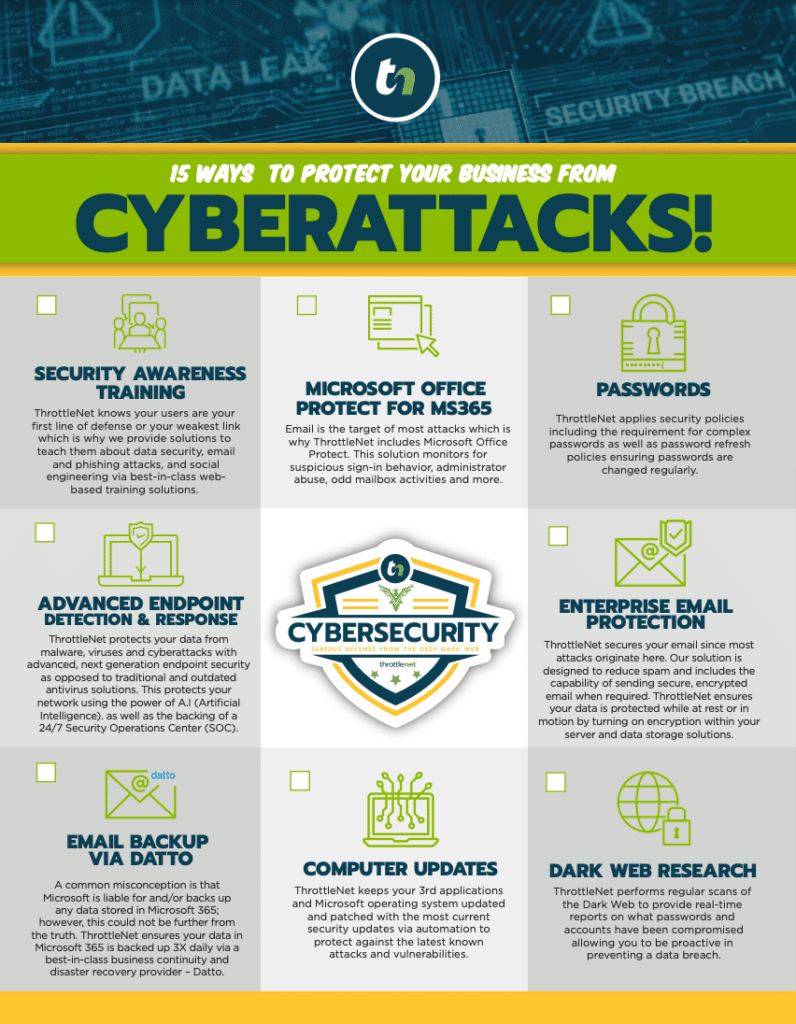
A co-managed partnership brings in a 24/7 Security Operations Center (SOC), persistent threat monitoring, and next-generation endpoint protection. Instead of your IT manager losing sleep over the latest vulnerability, they have a dedicated cybersecurity team monitoring the network around the clock. (It’s worth noting that this proactive approach is why ThrottleNet customers have never had to pay a ransomware attack, a standard we back with an exclusive $500,000 Cybersecurity Protection Program).
3. Strategic Guidance with a vCIO
A true co-managed partnership isn’t just about fixing broken computers; it’s about business strategy. ThrottleNet pairs every co-managed client with a dedicated Virtual Chief Information Officer (vCIO).
Unlike a traditional “account manager” who just tries to sell you hardware, a vCIO acts as an extension of your leadership team. They sit down with your internal IT manager and your executive team to build long-term technology roadmaps, manage IT budgeting, and ensure your tech investments are actually fueling business growth.
4. A Single Pane of Glass
To ensure total transparency and seamless collaboration, both your internal team and your external partner need to be looking at the same data. Tools like the TN TechHub provide an intuitive, all-in-one command center. Your internal IT team can track support tickets, monitor real-time network performance, and manage software licensing right alongside their co-managed partners, ensuring everyone is always on the same page.
Readiness Checklist: Is Co-Managed IT Right for Your Business?
If you’re wondering whether your Washington, MO business is a good fit for a co-managed IT partnership, ask yourself these five questions:
- Are strategic projects stalling? Is your internal team so bogged down by daily support tickets that they can’t focus on long-term initiatives?
- Are you worried about compliance or cyber threats? Do you lack the internal resources to monitor your network 24/7 or maintain strict industry compliance (like HIPAA or NIST)?
- Is your IT manager taking vacations with a laptop? If your business grinds to a halt when your IT person takes a day off, you have a critical single point of failure.
- Are you struggling to hire specialized IT talent? Are you finding it difficult (or prohibitively expensive) to hire full-time cloud architects or cybersecurity analysts?
- Is your IT budget unpredictable? Are you frequently hit with surprise costs for emergency fixes or unexpected hardware failures?
If you answered “yes” to two or more of these questions, a co-managed IT model could be the exact solution you need to regain control and accelerate your growth.
Frequently Asked Questions About Co-Managed IT
Will my internal IT manager feel threatened or replaced?
This is the most common concern, and it’s entirely understandable. The key is communication. When introduced correctly, internal IT teams love the co-managed model. It removes the tasks they hate (like resetting passwords at 8:00 AM) and allows them to focus on high-level, career-enhancing projects. It’s a tool to prevent burnout, not a fast track to replacement.
Who manages the external IT team?
It’s a collaborative effort. Typically, your internal IT leader acts as the primary point of contact, coordinating directly with the co-managed provider’s vCIO and engineering teams. You retain total control over your IT environment; the external team is simply there to execute the strategy you approve.
How does the pricing work? Do I have to sign a long-term contract?
Pricing is generally based on the specific services you need to augment your team—whether that’s just backend cybersecurity, or full help-desk offloading. Furthermore, a confident IT provider shouldn’t need to lock you in. ThrottleNet operates on a transparent, month-to-month pricing model. We believe in earning your business every single month through consistent, high-quality performance rather than trapping you in a multi-year agreement.
Empowering Your Team for the Future
For businesses in Washington, MO, technology should be an accelerator, not a bottleneck. You don’t have to choose between burning out your internal staff or spending a fortune to build a massive in-house IT department.
Co-managed IT services offer the perfect middle ground: maintaining the internal knowledge and cultural fit of your existing team, while supercharging them with the specialized expertise, rapid response times, and robust cybersecurity of an award-winning IT firm.
When your internal IT team finally has the backup they need, they stop putting out fires and start building the future of your business.