
Imagine it is the middle of a Tuesday in Washington, MO. A local manufacturing plant is finalizing a critical production run, or perhaps a busy accounting firm is pushing against a strict tax deadline. Suddenly, the network goes down. The ERP software freezes. An employee accidentally clicks a suspicious email link, and the system locks up.
In these moments, time isn’t just ticking—it’s actively draining revenue, productivity, and team morale.
For many businesses, the standard IT support protocol involves submitting a ticket into a digital void, waiting hours (or even days) for a response, and hoping the person who finally answers has the expertise to fix the problem. But what if that response happened in just 90 seconds?
Understanding how elite IT support structures operate can fundamentally change how you view your business’s technology. Let’s pull back the curtain on IT response times, explore the hidden costs of waiting, and uncover how a specific support architecture makes an industry-leading 90-second response time a reality for local businesses.

The Hidden Cost of Waiting for IT Support
When we talk about slow IT support, it is easy to brush it off as a mere annoyance. However, for a business leader, the “cost of waiting” is a measurable financial metric.
If you have a team of 30 employees who cannot access their primary software for an hour, you haven’t lost one hour of productivity, you have lost 30 hours. Add to that the delayed client deliverables, the potential for missed sales, and the sheer frustration that leads to employee burnout.
Most conventional Managed Service Providers (MSPs) operate on Service Level Agreements (SLAs) that promise a response within 15 to 60 minutes for “critical” issues, and often much longer for everyday hiccups. For a fast-moving business in Washington, MO, waiting an hour just to hear back from an IT vendor is an unacceptable bottleneck.
Decoding IT Metrics: Response Time vs. Resolution Time
As you evaluate your technology strategy, it is crucial to understand the language of IT support. Two terms are frequently used—and often confused: Response Time and Resolution Time.
Think of it like calling a tow truck when your car breaks down.
- Response Time is how long it takes for the dispatcher to answer the phone and say, “We have your location and we’re sending help.”
- Resolution Time is the moment your car is repaired or safely towed, and you are back on the road.
Both metrics matter immensely. A fast response time stops the panic. It validates that an expert is looking at the problem. But a fast response time means very little if it isn’t followed by a rapid resolution. The goal shouldn’t just be a quick “hello,” but a swift, accurate fix.
How a Multi-Tiered Help Desk Changes the Game
You might be wondering: How is it actually possible to achieve a 90-second average response time and resolve 93% of issues on the very same day?
The secret isn’t simply hiring more people; it is about how those people are organized. Most traditional IT providers use a “generalist” model. When you call in, you get whoever is available. If that person doesn’t know how to fix your specific cloud server issue, you get bounced around, put on hold, and delayed.
ThrottleNet approaches this entirely differently through a Multi-Tiered Help Desk backed by specialist teams. Here is how this architecture eliminates bottlenecks:
- Tier 1 Support Engineers: Built for rapid triage and fast fixes. They answer immediately and handle straightforward user issues so your employees can get back to work instantly.
- Tier 2 Support Engineers: Dedicated to deeper troubleshooting, complex software integrations, and system-level remediation.
- Tier 3 Support Engineers: Focused on advanced infrastructure, networking, and high-level escalations.
Because issues are immediately routed to the correct level of engineering talent—rather than sitting in a generic queue—problems are diagnosed accurately and solved the first time. Furthermore, bypassing the generalist approach means you have access to dedicated teams for Cybersecurity, Cloud Services, and IT Strategy.
The Local Advantage: Why Washington, MO Businesses Need Regional Support
Technology is global, but business is local. While massive, out-of-state IT conglomerates might offer slick software, they often lack the contextual understanding of a local business environment.
Having a dedicated IT partner in the region means your support isn’t coming from an anonymous, outsourced call center. It comes from a team that understands the Midwest business landscape. If a situation requires boots-on-the-ground support, a regional provider can dispatch a technician to your Washington, MO office without the logistical nightmares of national providers.
This local footprint, combined with over 700 verified 5-star Google reviews, builds a layer of trust and accountability that remote-only providers simply cannot replicate.
Shifting from Reactive to Proactive IT
The most efficient IT ticket is the one that never has to be submitted. While a 90-second response time is critical for putting out fires, true business continuity requires fire prevention.
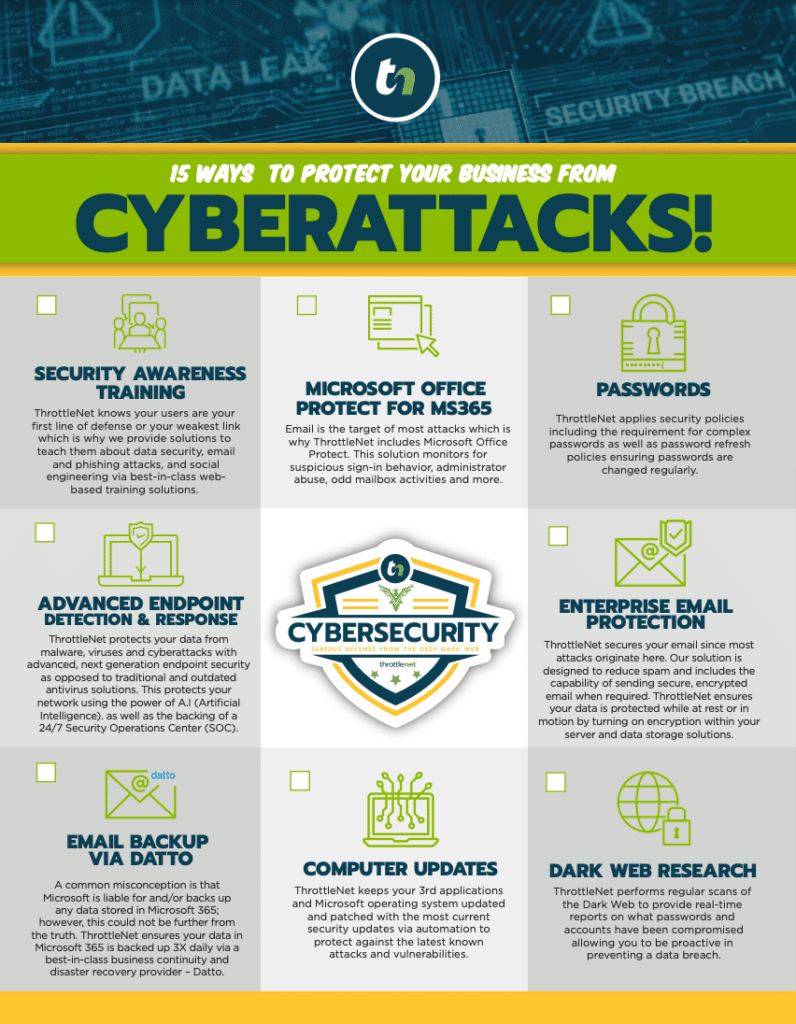
A modern IT strategy should include 24/7 proactive network monitoring, where systems are patched, updated, and optimized behind the scenes. It also requires embedded, enterprise-grade cybersecurity. With threats like ransomware targeting manufacturing and professional services daily, reactive IT is no longer enough.
By integrating an always-on Security Operations Center (SOC) and next-generation endpoint protection, businesses can dramatically reduce their risk profile. In fact, comprehensive protection is so vital that ThrottleNet backs its security stack with a one-of-a-kind $500,000 Cybersecurity Protection Program—and to date, no ThrottleNet customer has ever had to pay a ransomware attacker.
Every growing business also benefits from a dedicated Virtual Chief Information Officer (vCIO). Unlike a standard account manager who just checks in, a vCIO acts as an extension of your leadership team, building long-term technology roadmaps, managing IT budgets, and ensuring your technology aligns perfectly with your business goals.
Frequently Asked Questions (FAQ)
What is a standard IT response time for small businesses?
Industry standards typically range from 15 to 60 minutes for critical issues, and anywhere from 4 to 24 hours for non-emergency tickets. ThrottleNet has redefined this benchmark with an award-winning 90-second average response time.
Does a fast response time guarantee a fast fix?
Not inherently. A fast response must be paired with deep engineering expertise to ensure a fast fix. Because of our multi-tiered help desk structure and specialist teams, ThrottleNet pairs its 90-second response with a 93% same-day resolution rate.
Why shouldn’t I just use a generic, national IT provider?
National providers often rely on decentralized, generalist call centers. A regional provider offers hyper-fast remote support coupled with the ability to provide localized, onsite assistance when needed. Furthermore, a regional partner is highly invested in the local business community and operates with a higher level of direct accountability.
Next Steps for Your Washington, MO Business
Accepting slow IT support means accepting hidden taxes on your company’s productivity, security, and bottom line. Your team deserves technology that works seamlessly, and when it doesn’t, they deserve support that answers in seconds—not hours.
Understanding the difference between generic IT help and a strategically structured, multi-tiered support system is the first step toward reclaiming your team’s time. If you are ready to explore what a 90-second response time, embedded cybersecurity, and a dedicated vCIO could look like for your business, consider starting with a thorough evaluation of your current IT infrastructure. Assessing your risk exposure and system health today paves the way for uninterrupted growth tomorrow.