
Cybercriminals are now using AI to attack small and mid-sized businesses faster and more precisely than ever. A new Trump executive order confirms it — here’s what St. Louis businesses need to know, and how ThrottleNet can help.
If your business still treats cybersecurity as a back-burner issue, the threat landscape has already moved past you. Artificial intelligence isn’t just changing how companies operate — it’s changing how criminals attack them. Hackers are now using AI to automate attacks, find vulnerabilities faster, and execute breaches with a precision that the old security playbook was never built to stop.
And small and mid-sized businesses are squarely in the crosshairs. You don’t have to be a Fortune 500 company to be a target — you just have to be reachable. AI lets attackers scale up, which means the local bank, the regional clinic, the family manufacturer, and the professional services firm down the street are all now worth a criminal’s time. The cost of a single breach — downtime, lost data, regulatory exposure, and damaged trust — can be devastating for an organization without enterprise-sized resources.
This isn’t a future problem. It’s happening now — and the federal government just confirmed it.
The federal government just put it in writing
On June 2, 2026, President Trump signed the executive order “Promoting Advanced Artificial Intelligence Innovation and Security,” aimed at balancing AI innovation with national cybersecurity. Its implications stretch well beyond Washington, D.C. For small and mid-sized businesses in St. Louis and across the Midwest, the order is a clear signal: the era of AI-enabled cyber threats is here, and the organizations that prepare now will be the ones that come out ahead.
Key takeaways from the executive order:
• Federal agencies must strengthen cybersecurity across government systems and critical infrastructure within 30 days.
• A new AI cybersecurity clearinghouse — led by the Treasury — will coordinate vulnerability scanning and patch distribution.
• A voluntary pre-release framework for frontier AI models will be finalized by August 1, 2026.
• The Attorney General is directed to prioritize enforcement against anyone using AI to illegally access or damage computer systems.
• Community institutions like rural hospitals, local utilities, and community banks are specifically named as targets for expanded cybersecurity support.
Three things the order tells us about where threats are heading
The executive order doesn’t impose new mandatory rules on most businesses — but it does paint a clear picture of where the threat landscape is going. Reading between the lines reveals three trends every business leader should understand.
• AI is supercharging cyberattacks. The order’s focus on criminal enforcement specifically calls out adversaries who “utilize AI to illegally access or damage” systems and those who “employ AI agents to unlawfully access data.” In plain terms: hackers are using AI to automate attacks, identify vulnerabilities faster, and execute breaches with far greater precision than ever before.
• Critical infrastructure — including local businesses — is in the crosshairs. The order specifically mentions community banks, rural hospitals, and local utilities as targets needing stronger protections. If your business serves or operates within any of these sectors — or depends on them — your risk exposure is directly connected to theirs.
• Voluntary today, mandatory tomorrow. The order takes a light-touch, voluntary approach for now. But history tells us that today’s voluntary federal cybersecurity frameworks often become tomorrow’s compliance requirements. Businesses that build strong security postures proactively will be better positioned when regulations inevitably tighten.
What this means for you: The federal government is ramping up AI-powered defensive tools — but those tools are primarily aimed at protecting government systems. Private businesses need their own proactive cybersecurity partner to close the gap.
How ThrottleNet helps St. Louis businesses stay protected
For over 25 years, ThrottleNet has helped St. Louis businesses navigate an evolving threat landscape. The AI era doesn’t change that mission — it makes it more urgent. Here’s how our core services directly address the risks this executive order highlights:
• Managed IT Services — Proactive monitoring and management of your entire IT environment, so AI threats are caught before they become breaches.
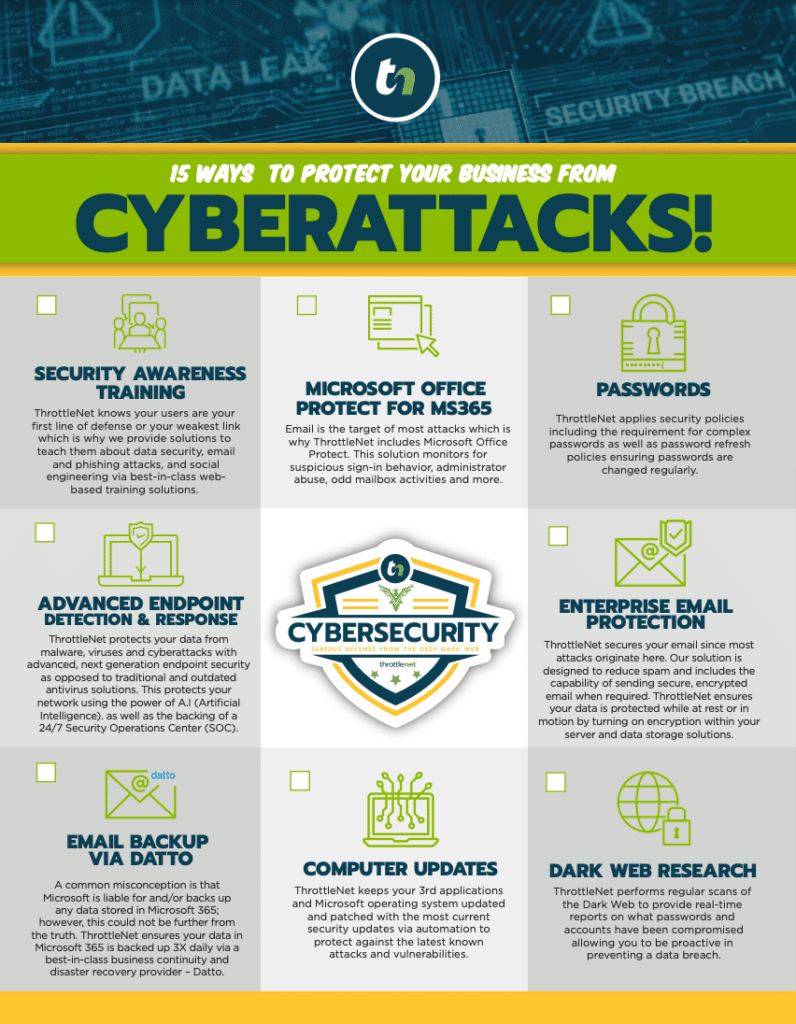
• Cybersecurity Solutions — Layered defenses including endpoint protection, threat detection, and incident response tailored to your business size and risk profile.
• Security Awareness Training — Your team is your first line of defense. We equip employees to recognize and respond to AI-powered phishing and social engineering attacks.
• Backup & Disaster Recovery — When (not if) something goes wrong, our recovery solutions minimize downtime and data loss, keeping your business operational.
The bottom line: AI-powered threats require AI-aware defenses
The Trump administration’s executive order is a clear acknowledgment from the highest levels of government that AI has fundamentally changed the cybersecurity landscape. Threat actors are leveraging AI to move faster, target more precisely, and evade traditional defenses. The question for every business isn’t whether AI-driven threats will reach them — it’s whether they’ll be prepared when they do.
ThrottleNet works alongside St. Louis businesses every day to build security postures that match the sophistication of modern threats. Whether you’re a community bank, a healthcare provider, a manufacturer, or a professional services firm, we bring enterprise-grade cybersecurity expertise scaled to your needs and budget.
Wondering how prepared your business really is? Start with a conversation. Our team will help you assess your current risk posture and build a roadmap that keeps pace with an AI-driven threat environment. https://www.throttlenet.com/contact/