

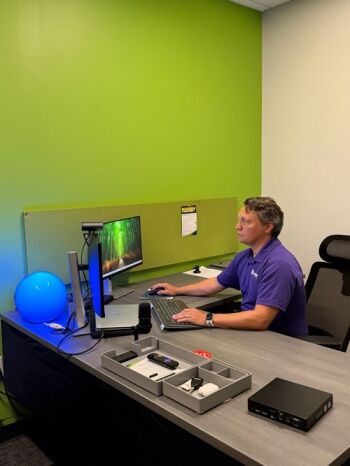
South County has no downtown, so most small businesses here run from a suite or a storefront along a busy road, usually with nobody on staff whose whole job is IT. At ThrottleNet, we provide South County IT support for local SMBs from our office on Maurer Industrial Drive in south St. Louis County, and our help desk is built around one question you care about when a computer stops: who picks this up, and how soon is it fixed?
ThrottleNet supports small and midsize businesses across South County, the southern part of St. Louis County, through a multi-tiered help desk. Tier 1 engineers handle quick fixes, Tier 2 takes deeper system problems, and Tier 3 handles networks, servers and complex escalations. Because each request is routed to the right level at once, problems get solved faster. Per ThrottleNet’s Customer Thermometer survey data, the help desk averages a 90-second response time, and ThrottleNet resolves 93% of tickets the same day.
In this article
How South County IT Support for Local SMBs Works, One Tier at a Time
Your request goes to the engineer with the right skills the moment it comes in, and that routing is the reason problems get solved faster. Our multi-tiered help desk splits support into three levels, each staffed by engineers who handle a particular depth of problem, so a password lockout at your front desk and a failing firewall in your back room never wait in the same line.
- Tier 1: fast triage and rapid fixes. Password resets, account access, Microsoft 365 sign-in trouble and basic troubleshooting, the everyday requests that keep one person from working.
- Tier 2: deeper troubleshooting. Recurring device failures, application configuration, network problems affecting several desks, and fixes that need changes to your systems.
- Tier 3: advanced infrastructure and complex escalations. Servers, networking, security events, third-party vendor issues and problems that touch the whole office.
A request moves up a tier when it needs more skill, more system access or more time than the current level should spend on it. The details from your first message (who is affected, what changed, what the screen says) travel with the ticket, so the next engineer never starts over. During onboarding, we train your team on how to request support and what to expect when they do, which makes that first message more useful.
When a ticket closes, our Partner Care team reviews it for accuracy and customer satisfaction. We support your IT everything, and the tiers are how that stays manageable for a small office with no IT department of its own.
What the 90 Seconds and 93% Measure
A fast first response and a full resolution are two separate measures, and any provider you talk to should be able to show you both. Service-desk benchmarking tracks speed of answer and first-contact resolution as different numbers for that reason.
Per ThrottleNet’s Customer Thermometer survey data, our help desk averages a 90-second response time. We also resolve 93% of support tickets the same day. The first figure tells you someone picks up your request quickly. The second tells you that, in most cases, the person who asked is back at work before the day ends.
Here is how one client described the chat side of it: “If there is an issue with my computer, all I have to do is click an icon on my desktop and i’m immediately placed in a chat with a member of the company.” That’s Miranda Reynolds, Senior Paralegal at Avery Law. A 98%+ happiness score in the same survey data shows how clients feel about moments like that.
Our people have a reason to care about those scores. Under the open-book management model we adopted in 2010, ThrottleNet employees share monthly profits tied to client satisfaction and service quality, so the engineer working your ticket has a stake in how it ends.
What Your Managed IT Services Cover Beyond the Help Desk
The help desk is the part you see; the rest of a managed IT services plan works in the background to keep your people productive and your networks secure. For a South County business, that plan typically includes:
- 24/7 proactive network monitoring, patch management and preventative maintenance
- A 24/7 Security Operations Center, next-generation endpoint protection, advanced email protection and dark web monitoring
- Microsoft 365 support and managed cloud solutions from a dedicated cloud services team
- Ongoing backup verification and business continuity and disaster recovery planning
- TN TechHub, the portal where you track tickets, monitor IT performance, view your software and endpoint inventory, and plan with your vCIO
Security is part of the plan, backed by our $500,000 Cybersecurity Protection Program, and no ThrottleNet client has ever paid a ransom. Every client gets a dedicated vCIO from our seven-person strategy team for budgeting, compliance and technology planning. New clients move through a 30-day onboarding that sets up monitoring and cybersecurity protection from the first day. Offices that already employ an IT person can choose co-managed IT, which adds our engineers and a vCIO alongside that person.
Close to Home in South County
Our office on Maurer Industrial Drive puts our team right around the corner, not three time zones away, and it anchors our wider IT support across St. Louis. From there, ThrottleNet provides 24/7 remote support, and our engineers come onsite when a problem needs hands on the hardware, which is why local onsite IT support matters so much to a small office.
The work South County residents do helps explain why fast support matters here. Per Claritas figures published by Think Health St. Louis (March 2026), the largest share of working residents in the South region are in health care and social assistance (about 15%), followed by retail (about 11%), manufacturing (about 10%), and finance, insurance and real estate (about 8%). Those numbers count residents rather than employers, but they point to a lot of small, customer-facing offices where one locked computer can stall the front desk.
If your business fits one of those groups, our other South County guides go further: medical and dental practices; insurance, accounting and financial offices; salons, fitness studios and home-service businesses; point-of-sale and Wi-Fi for retail and restaurants; and planning for storms, floods and power outages.
Questions to Ask Any IT Provider Before You Sign
Ask every managed service provider the same questions, and weigh each answer by the proof behind it.
- Who answers when someone on my team needs help, and how fast, on average? Ask for the measured figure and its source.
- What does each tier fix, and how does a request move between them? Ask for an example of a ticket that moved from Tier 1 to Tier 3.
- What share of tickets are resolved the same day?
- What security and backup evidence can you give my cyber insurer? Many carriers now ask for proof at renewal, such as multi-factor authentication, endpoint protection, isolated backups and security training records, and requirements vary by carrier.
- What happens in the first hours after a breach? You want a named process for containment, recovery and the notices the law requires.
The stakes for small businesses are real. In Verizon’s 2025 breach report, ransomware showed up in 88% of breaches at businesses with fewer than 1,000 employees, against 39% at larger organizations. Missouri’s breach notification law (RSMo 407.1500) sets notice duties for any business holding residents’ personal information, and the attorney general can seek a civil penalty of up to $150,000 per breach for willful and knowing violations. This is general information, not legal advice.
Frequently Asked Questions
Is the 90-second response time a guarantee?
No, it is an average drawn from completed customer surveys, so some requests get a reply sooner and some later. When any provider quotes a response time, ask whether it is an average or a promise, and how many responses it is based on.
Will someone come to my South County office, or is support remote?
Most requests start with your team clicking the desktop chat icon or opening a ticket in TN TechHub, and the help desk takes it from there. When the hardware itself needs attention, an engineer travels from our south St. Louis County office, with timing set by the problem.
What areas count as South County, and do you serve them?
There is no official boundary, so the answer depends on who you ask. South County generally takes in Affton, Concord, Crestwood, Green Park, Lemay, Mehlville, Oakville, Sappington and Sunset Hills; much of it is unincorporated, while Crestwood, Green Park and Sunset Hills have their own city governments. ThrottleNet supports businesses in and around all of these communities.
What does Missouri law require after a data breach?
You must notify affected Missouri residents without unreasonable delay, and if you only hold the data for another company, you must tell that company immediately after you discover the breach. If you notify more than 1,000 people at once, you also have to tell the attorney general and the nationwide consumer reporting agencies.
What services do small businesses need from IT support?
A workable minimum is a help desk, monitoring and patching, endpoint and email security with multi-factor sign-in, Microsoft 365 administration, backups you check by actually restoring them, and a routine for adding and removing employee access.
Start With a Free On-Site Assessment
The simplest way to see how this would work for your office is a free on-site assessment and security report. One of our engineers reviews your risk exposure, system health, user experience and IT processes, so you learn where your business stands before you decide who should manage your technology. Many providers offer assessments; ask what each one actually checks. ThrottleNet has been named the #1 IT Firm in St. Louis by St. Louis Small Business Monthly for 13 consecutive years, and we earn your business every month after the assessment, too. You stay because you want to.

Author: George Rosenthal – President & Co-Owner

