If you own or manage a business you’ve probably had this thought: “We’re a small logistics company (or healthcare clinic, or accounting firm). Hackers only care about Wall Street and Fortune 500s. Why would they target us?”
It’s a comforting thought. Unfortunately, it’s completely false.
Cybercriminals aren’t just looking for massive payouts; they’re looking for easy targets. And the easiest way into any corporate network isn’t by hacking a complicated firewall—it’s by tricking a human being into opening the front door.
Local businesses are actively under siege. In recent years, we’ve seen the devastating BJC Healthcare phishing breach that compromised sensitive employee and patient accounts. Just down the road in Clayton, a local wealth management firm had $1.1 million stolen straight from their accounts through a sophisticated email fraud scheme.
These weren’t failures of technology. They were manipulations of human psychology.
In this guide, we’re going to pull back the curtain on how modern cybercriminals target Midwest businesses. More importantly, we’ll show you how to transform your employees from your biggest vulnerability into an impenetrable “Human Firewall.”

The “Behavior Over Compliance” Aha Moment
For years, the standard approach to cybersecurity training has been treating it like a compliance chore. HR hands a new hire a dusty handbook, makes them watch a dry, 45-minute corporate security training video, and has them sign a piece of paper.
But does this actually work?
According to a recent UC San Diego study, standard corporate training programs do incredibly little to stop employees from falling for phishing attacks. The study revealed a massive gap between generic, compliance-driven theory and real-world behavioral change.
Here’s the “aha moment”: Clicking a malicious link isn’t a technical error. It’s a psychological one.
Scammers use universal human triggers—urgency (“Your account will be suspended in 24 hours”), authority (“This is the CEO, I need a favor”), and fear (“We have detected a breach on your device”). Generic training teaches employees what a phishing email is. Modern behavioral training conditions employees on how to react when their psychological buttons are being pushed.
Anatomy of a Local Scam: How Businesses Get Targeted
To understand why generic training fails, you have to look at the hyper-local, highly sophisticated threats your team is facing right now. The days of the “Nigerian Prince” scam are long gone. Today, attacks look remarkably normal.
1. Phishing and Spear-Phishing (The Fake Vendor Invoice)
Phishing involves sending fraudulent emails that appear to come from a reputable source. But spear-phishing is highly targeted.
Imagine your accounts payable clerk receives an email that looks exactly like an invoice from a St. Louis-based logistics company you actually do business with. The logo is right. The sender’s name is familiar. The email simply says, “Hi, please note we have updated our banking routing details for this month’s invoice. Please wire payment to the new account below.”
If your employee hasn’t been conditioned to verify payment changes via a secondary method (like a phone call), that money is gone.
2. Social Engineering (The Human Hack)
Social engineering is a broad term for manipulating people so they give up confidential information. This doesn’t just happen over email. It includes “tailgating” (someone carrying a heavy box following an employee through a secure keycard door at your office) or a fake IT support technician calling your receptionist and asking to reset their password.
3. AI Voice Cloning and Deepfakes (The New Frontier)
Criminals are now using artificial intelligence to scrape audio of your company’s executives from public podcasts, webinars, or social media. They then use AI voice-cloning (deepfakes) to call an employee and urgently demand a vendor payment or password reset. To the employee, it sounds exactly like the boss.
Why Your Current Defenses Aren’t Enough
You might be wondering: “If we use expensive spam filters, antivirus software, and robust cloud security, why do we need to train our end-users?”
Because criminals have adapted. They know it’s incredibly difficult to break through enterprise-grade cybersecurity tools. So, they bypass the software entirely and target the human layer. If an employee willingly hands over their Microsoft 365 credentials on a fake login page, the spam filter doesn’t matter. The hacker just walks right in, fully authenticated.
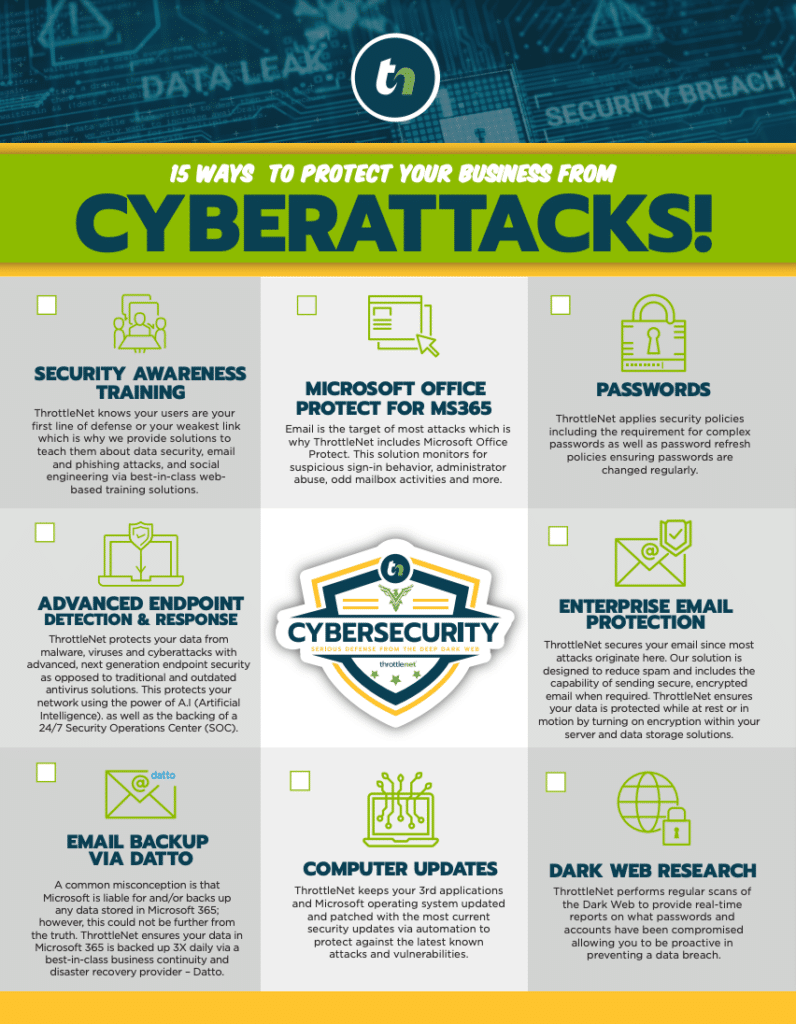
This is why having a proactive IT partner matters. At ThrottleNet, we’ve seen that a multi-layered defense is required. Yes, you need 24/7 network monitoring, DNS web filtering, and next-generation endpoint security. But you also need a workforce that knows how to spot the threats that inevitably slip through the cracks.
The 2026 Blueprint: Building a Training Program That Actually Works
If dry videos don’t work, how do you actually protect your business? You need a localized, behavior-changing curriculum. Here is how leading businesses are transforming their teams.
1. Establish a Baseline with Simulated Testing
You can’t fix what you haven’t measured. Before implementing any training, organizations should run a baseline phishing simulation. This involves sending a safe, fake phishing email to your entire staff to see how many people click the link or enter their credentials. The results are often a wake-up call for leadership.
2. Train for Behavior using Interactive Platforms
Instead of one massive training session a year, the most secure companies use continuous, bite-sized behavioral conditioning. Platforms like KnowBe4 allow you to send brief, interactive modules monthly. More importantly, they allow you to continuously run localized phishing simulations. If an employee clicks a fake malicious link, they are instantly given a 3-minute micro-training on exactly what red flags they missed.
3. Implement Strong HR Security Onboarding
Cybersecurity training shouldn’t be an afterthought; it should begin on day one. A strong HR security onboarding checklist should include:
- Reviewing the company’s acceptable use policy.
- Training on how to use a password manager.
- Setting up Multi-Factor Authentication (MFA) on all accounts.
- Teaching “home security awareness tips” for remote workers (like securing their home Wi-Fi and never sharing work devices with family members).
4. Foster a “No-Blame” Reporting Culture
If an employee clicks a bad link and realizes their mistake, what do they do? If your company culture punishes mistakes, they will likely stay quiet out of fear of getting fired, giving the hacker hours or days to roam your network.
You must cultivate a “no-blame” culture. Employees need to know that if they make a mistake, their first call should be to IT support immediately. (This is where having a managed service provider with a rapid response time is critical. ThrottleNet’s multi-tiered help desk averages a 90-second response time, allowing our engineers to quarantine a compromised machine before the threat spreads).
Frequently Asked Questions (FAQ)
What exactly is employee cybersecurity training?
Employee cybersecurity training is an ongoing educational process that teaches your staff how to recognize and respond to digital and physical security threats. Modern training moves beyond policy memorization and uses simulated attacks to build real-world reflexes against hackers.
What is the difference between phishing and social engineering?
Social engineering is the overarching psychological manipulation used by hackers to trick people into breaking normal security procedures. Phishing is just one specific type of social engineering—specifically, using fraudulent emails to steal data or money.
Are we too small to be targeted by hackers?
Absolutely not. Small and medium-sized businesses (SMBs) are actually the preferred targets for many cybercriminals because SMBs typically have smaller IT budgets and less rigorous security training than large corporations. A hacker views an unprepared St. Louis business as low-hanging fruit.
How do I secure my remote workers’ home networks?
Remote work blurs the lines between corporate and personal security. You should provide home security awareness tips, mandate the use of company-approved VPNs, enforce Multi-Factor Authentication (MFA), and ensure that personal devices are never used for accessing sensitive corporate data.
Your Next Steps: Building the Human Firewall
Your employees are the lifeblood of your business. With the right education, they don’t have to be your biggest security risk—they can be your most effective alarm system.
Protecting a business today requires strategic alignment between your people, your processes, and your technology. It requires a dedicated IT strategy that looks ahead, which is why having access to a Virtual Chief Information Officer (vCIO) can be a game-changer for long-term technology roadmaps and compliance planning.
When you combine a highly trained staff with an IT support partner that boasts a 93% same-day resolution rate, continuous 24/7 monitoring, and an exclusive $500,000 Cybersecurity Protection Program, you stop worrying about technology and start focusing on growth.
Ready to see where your team stands? The best place to start is by testing your current defenses. Consider running a localized phishing simulation to get a baseline vulnerability score for your staff. It’s the first step toward turning cybersecurity frustration into lasting peace of mind.